A summary of Mikhail Sholokhov’s "Mortal Enemy"
 Automatic translate
The work was created in 1926. This book is a harsh narrative of irreconcilable class hatred in a Don village in the early years of Soviet power.
Based on this story and the work “The Two-Husband,” in 1971 director Yevgeny Matveyev made the feature film “Mortal Enemy.”
This story is part of the "Don Stories" series. This series includes such works as "The Birthmark," "The Food Commissar," "The Shibalkovo Seed," and other texts about the tragedy of the civil war in the Don region. The book has no official serial number.
Elections to the Council and the split in society
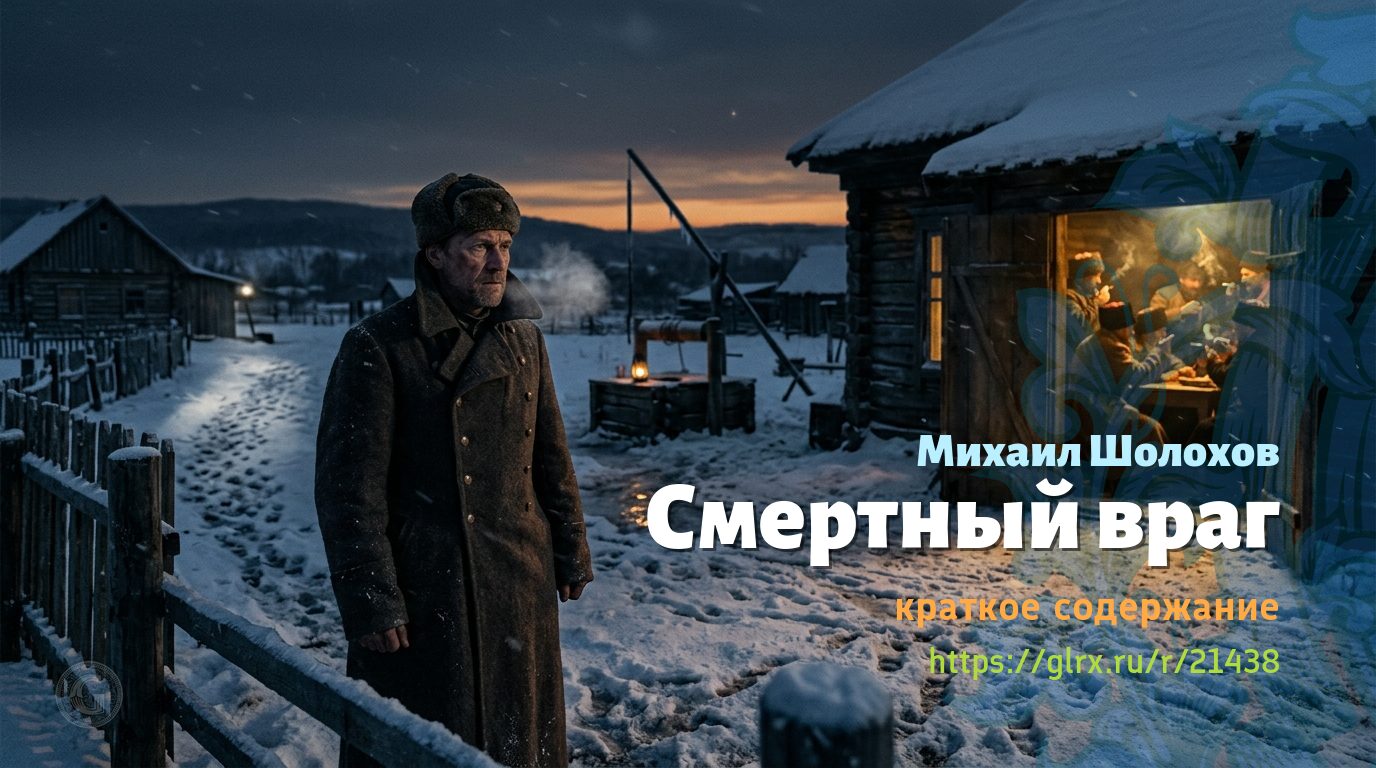
A winter evening descends on the Podgornoye farmstead. The orange, unwarming sun disappears behind the sharply defined horizon. The first shy star appears above the well crane. The frost intensifies. After dinner, Yefim Ozerov goes out into the yard. He wraps his old soldier’s greatcoat tightly around himself and turns up the collar.
Yefim heads to the village meeting in the last yard near the old school. The hut is smoky, and tobacco smoke wafts. In the middle of the room, a lop-eared heifer leaves a puddle on the dirt floor. The former Red Army soldier greets them, but receives an unfriendly, reserved response from the wealthy Cossacks gathered there.
Ignat Borshchev mockingly predicts Yefim will become the Council Chairman. The wealthy farmers are trying to intimidate this man from the poor class. They want to see their man in power, someone willing to look them in the eye. Yefim firmly refuses to dance to the rich man’s tune. Ignat reminds him that in the spring, the poor always come to him, bowing and asking for help. He boasts about lending Dunka Vorobyova sixteen kilograms of millet. Yefim immediately exposes Ignat — for this grain, the girls weeded his gardens all summer and bent their backs haying.
Vlas Timofeevich rudely yells at Yefim over the poor man’s constant complaints about his crops being hidden from the state. Ignat raises his hand, calling Yefim a mortal enemy and a rabid dog. The vote begins. The meeting secretary announces the election results. Prokhor Rvachev and Yefim Ozerov receive the most votes. Returning home at midnight, Yefim informs his wife Masha of his election as Council Secretary. Prokhor Rvachev, Ignat Borshchev’s son-in-law, becomes the chairman.
Night conspiracies and bribery attempts
The Podgornoye farmstead is divided into two camps. On one side stands the poor peasants, led by Yefim. On the other are Ignat, his son-in-law and chairman, the miller Vlas, and the wealthy Cossacks. On Sunday evening, Ignat tries to win over Ivan Donskov. He offers the middle peasant favorable terms in exchange for plowing the good land near the Portable Pond. Ivan sternly questions Ignat’s intentions and leaves. That same evening, Yefim calls on the young people to act independently and stop asking the kulaks for help.
On a dark, frosty night, the wind whips through the streets of Podgorny. Conspirators gather near the school fence. They shelter from the wind and smoke, cigarettes glowing in the darkness. Subdued whispers are heard. One of the men complains that the new secretary is meticulously checking contracts with farm laborers. A proposal is made to kill Yefim. The unknown interlocutor is initially frightened, but then agrees to save his farm from taxes.
In the morning, Ignat and Vlas the Miller arrive at Yefim’s house. The guests hypocritically talk about fresh snow and hare hunting. Vlas invites Yefim to move to the village of Kalinovka. They promise to help him buy an outbuilding on an installment plan. Yefim realizes the true purpose of their visit. He turns purple with anger and sends the guests away. Yefim grabs Ignat by the collar of his coat and throws him off the porch. Ignat falls, his lips bleeding, and threatens to carry Yefim out of the house feet first.
Before Christmas, a tearful worker named Dunka comes running to Yefim. Ignat had kicked her out of the yard after two years of hard labor. The owner refused to pay her. Dunka is illiterate and didn’t sign the contract. Yefim takes out a piece of wrapping paper, makes some ink, and writes a complaint to the People’s Court of Precinct Eight.
Destruction of livestock and reprisal against a dog
The conflict escalates into an open phase. Ignat secretly steals half of Yefim’s mown hay. The cart’s wheels leave a clear trail all the way to the rich man’s threshing floor. Then Ignat catches two small, helpless wolf cubs in Krutoy Log. Returning to the farm, he breaks the cubs’ necks and throws them over the five-foot fence into Yefim’s yard. That night, the she-wolf descends to the windmill. The animal leaps over the fence.
In the morning, Yefim finds dead wolf cubs and a torn-open sheep with steaming intestines. A few days later, a she-wolf breaks through the thatched roof of the barn and silently slaughters Yefim’s last cow. The baby is left without milk.
Yefim takes the cow’s skinned remains to the clay pit. Then he heads straight to Ignat’s yard. The owner is hacking at ribs with an axe for a new cart. Ignat boasts about his busty greyhound named Razboy. Ignat says he traded a cow and her calf for the dog. Yefim calmly takes the axe. He makes a short swing and splits the dog’s skull in two. Hot clumps of brain matter spray onto Ignat. Yefim explains the reason for his actions, promises to repay evil with evil, and walks away.
Rifle misfire and open confrontation
The court orders Ignat to pay Dunka sixty rubles. Presiding judge Prokhor Rvachev cautiously asks Yefim the name of the person who filed the lawsuit. Yefim smiles and openly admits to his crime. That evening, he takes his work home. Masha couldn’t buy chintz for the curtains because she’d spent two meters of fabric on her son’s diapers. The windows remain open to the prying eyes of strangers from the street.
The wind whips up drifting snow, and the swaying willows by the river hum. Yefim is rewriting a mandatory regulation with homemade oak berry ink. Suddenly, the shutter opens slightly. Familiar gray eyes and the black hole of a rifle barrel stare at Yefim through the tangled frost. A click sounds — the gun misfires.
Yefim manages to blow out the flame from the lamp and duck his head. A second shot shatters the glass and pierces the wall. Yefim crawls on all fours. His wife cries hysterically on the bed. The shooter fires another errant shot from behind a half-open shutter and runs away down the street. In the morning, Yefim finds two empty shells and a cartridge with a black dent in the piston in the snow. He accuses Prokhor Rvachev of the shooting and mentions the damp cartridges. The chairman turns purple and feigns incomprehension.
Rumors of the assassination attempt spread throughout the village. Ivan Donskov promises Yefim the full protection of the poor. That evening, young people gather at Fedka the shoemaker’s. Vaska Obnizov warmly whispers words of support to Yefim. He says, "Remember, Yefim, if they kill you, there will be twenty more Yefims."
Ice pursuit and murder
Yefim heads to the village early in the morning on business. He visits the executive committee, the credit union, and the police. It’s getting dark. The frost prickles his cheeks. Yefim walks home across the smooth ice of the frozen river. Two hundred meters behind him, he spots three pursuers. The men are walking quickly in a group, gradually closing the distance.
Yefim breaks into a trot. He runs, keeping his elbows tucked tightly into his sides. The bank is covered in deep snow, so Yefim continues running across the slippery ice. Suddenly, he stumbles and falls. The man in front quickly catches up, swinging a stake. Yefim realizes the futility of calling for help — the village is over a kilometer away. No one will hear his call. He presses his lips together and silently charges forward.
A thrown stake slides swiftly across the ice with a dull clang. A powerful blow knocks Yefim off his feet. He jumps up again and runs, remembering the hot, suffocating attacks near Tsaritsyn. Another well-aimed throw of the stake finally knocks him to the ice. A terrible blow lands from behind, hitting his head, knocking him aside. Yefim gathers all his willpower into a lump of iron and tries to rise to all fours, but is thrown backwards. His consciousness grows clouded. Near the shore, a broken reed stalk is visible.
The killers act mercilessly. They drive a stake deep into Yefim’s mouth, breaking his teeth and twisting his gums. Then they pierce his chest with pitchforks. The metal teeth pass right through and bend, piercing his spine. Three men light cigarettes and walk quickly toward the farmstead. Greyhounds hurry after one of them. A blizzard begins. Snow falls on the face of the dead Yefim. The snowflakes no longer melt on his cold cheeks, where two tears of unbearable pain and horror are frozen forever.
- A few words about the portrait
- The Russian Museum presented an exhibition of Russian artist Andrei Martynov
- "An Old Friend is Better Than Two New Ones" by Alexander Ostrovsky, summary
- A summary of "The Jokers" by Alexander Ostrovsky
- Mikhail Sholokhov’s "Alien Blood," a summary
- Mikhail Sholokhov’s "Wormhole," a summary
You cannot comment Why?