"Paper Theater. Non-Prose" by Lyudmila Ulitskaya, summary
 Automatic translate
A collection of autobiographical essays, plays, and screenplays was published in 2020. The author presents texts from his personal archive, previously unseen in print: unseen scripts, plays, diary entries, and recollections of loved ones, complemented by reflections on the nature of art, memory, and the fate of a generation.
Theatrical experience and the nature of the stage
The narrative opens with recollections of childhood impressions of performances at the Moscow Art Theatre and Peter Brook’s tours. After leaving the Institute of Genetics in 1979, the author took a position as head of the literary department at the newly founded Chamber Jewish Musical Theatre in Moscow. Working with the artists Ilya Glazunov and Sergei Barkhin, adapting classical plots, and staging plays like "The Black Bridle of the White Mare" and "Tevye of Anatovka" shaped her understanding of the rules of the stage. A playwright creates a semi-finished product, while the director determines the final form of a performance entirely. Theatrical impressions are complemented by analyses of performances of Sophocles in Epidaurus, Rimas Tuminas’s Oedipus Rex at the Vakhtangov Theatre, the Genoese production of Carmen, Alexander Sokurov’s production of Go, go, go in Vicenza, and Kirill Serebrennikov’s ballet Nureyev.
"Liberty Sisters"
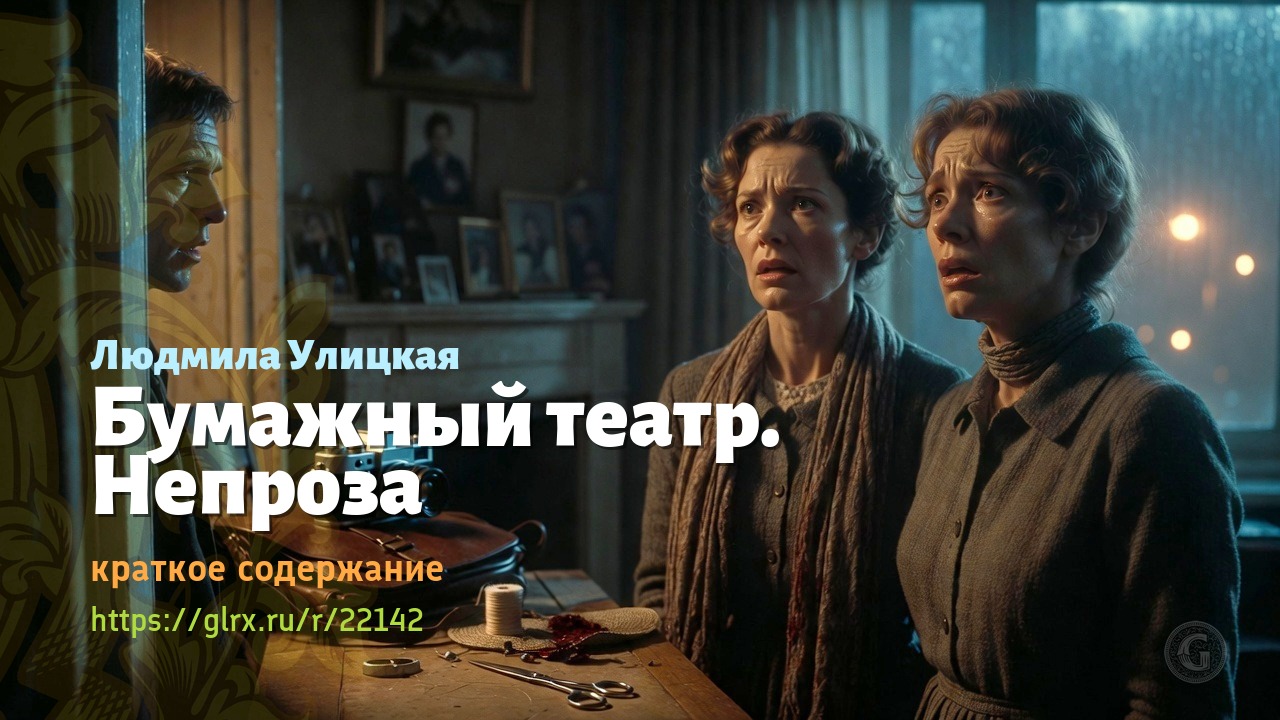
The film follows the lives of two twin sisters, Lyuba and Vera, vocational school seamstresses. The girls meet an artist and photographer named Serge, who works in the Art Nouveau style. Serge undertakes to mold these provincial seamstresses into sophisticated models. He alters their gait, shaves their eyebrows, teaches them body language, and introduces them to the world of bohemia.
Vera becomes infatuated with photographer Vadim, but he announces his imminent marriage to a foreigner and his imminent departure to London. In despair, Vera drinks poison. Doctors miraculously save her in intensive care. Lyuba, seeking revenge on her sister’s abuser, turns to her grandfather in the village for magical powers and furiously shreds Vadim’s cap with scissors. Soon news arrives: Vadim has suffered a stroke in London.
Serge introduces the recovered Vera to the Italian art critic Guido. The Italian falls in love with her and proposes. On the eve of her departure, Lyuba, tormented by envy and the fear of loneliness, cuts her hair, dons Vera’s clothes, and tries to pass herself off as her sister, threatening to ruin the marriage. Driven to despair, Vera rushes to meet the young man Zhenya, goes out with him to the attic window, and falls to her death, shattering the glass. The finale shifts the action to Rome, where Guido is happy with his young Russian wife: the signora receives a telegram from Moscow about her sister’s death, crumples the paper, and claims that she is left completely alone in the world.
Family Ties and "Anniversary. Take Two"
An essay on the transformation of the family institution gives way to a play dedicated to the eightieth birthday of actress Nina Viktorovna. In the first act, the family gathers for a home celebration. The feast escalates into the revelation of long-held secrets: it is revealed that Sister Lydia’s daughter, Vera, is actually the father of Nina Viktorovna’s late husband, the scientist Nikolai Georgievich. The sisters maintained silence for many years for the sake of everyone’s peace.
The second act unfolds as an alternative version of the anniversary: the celebration is disrupted by accidents involving the grandchildren. Kirill Alexandrovich, a longtime friend and stage partner, appears in the empty apartment, wearing a fake horse’s head. In their dialogue, the actors try out classic lines from Pushkin and Chekhov, and Nina Viktorovna confesses to Kirill that her son Georgy is his biological child.
Inner Circle: In Memory of Mikhail Novikov and Dmitry Shakhovsky
A special place in the memoirs is occupied by the circle of friends that formed during the Soviet decades as a support system for personal survival. The author describes the funeral of her close friend Mikhail Novikov (Aronych) at the Père Lachaise Cemetery in Paris in 2017, recalling events connected with him and the incident when the ailing Novikov helped a young man with cerebral palsy overcome his condition and perform a parachute jump.
A separate essay is dedicated to the sculptor Dmitry Shakhovsky, the son of priest Mikhail Shik, who was executed in 1937. Shakhovsky emerges as a man of rare inner dignity, a Christian who eschewed falsehood and compromise with the authorities. The text includes family letters from the front and in the camps, scenes from life in Maloyaroslavets, and a description of the sculptor’s funeral at Troekurovsky Cemetery in 2016.
Disabled People
The essay addresses the hushed-up tragedy of World War II veterans. Official reports from the Military Medical Museum attest to millions of crippled front-line soldiers. The author recalls Moscow courtyards in the late 1940s and the wave of post-war purges of impoverished disabled people, exiled by the authorities to closed monastery boarding schools on Valaam, Goritsy, and Kirillov.
Among the essays, the stories of artist Gennady Dobrov, who captured the inhabitants of Valaam, legless sailor Vasily Petrogradsky, who created a choir of paralyzed soldiers at the Goritsky Monastery, legless pigeon fancier Uncle Pasha from Moscow’s Invalidny Market, and academician Boris Lapin, who survived the war with a prosthesis and saved colleagues during the anti-Semitic campaigns of 1953, stand out.
Bosch’s Children
A fantastical scenario connects the medieval visions of Hieronymus Bosch with a future catastrophe. In the 15th century, monks of the secret society of Saint Catherine at the Tizienne monastery encounter an epidemic of half-lizard babies being born. Summoned, Eastern magicians halt the plague with a spell for five and a half centuries and hide an ampoule of pure blood in a parallel world.
In the 21st century, disaster returns: humanity is losing fragments of its genome everywhere, and women are once again giving birth to monsters. Virologist Tatyana Larina and art historian Vadim discover clues in the ruins of a Pyrenean monastery and, with the help of physicist Vasya Tsoi, penetrate the space of the painting "The Garden of Earthly Delights" through a laser collider.
Having obtained a vial of pure blood, Tatyana synthesizes a drug based on a rapidly spreading respiratory virus and illegally sprays it at train stations and airports. The infection gives humanity a chance to save its genome, and Tatyana herself is expecting the birth of a healthy first child.
"Ciao, CHOW!"
The play, in montage form, combines concepts of Russian cosmism: Nikolai Fyodorov’s teachings on the "resurrection of the fathers" and the overcoming of sexual reproduction, Konstantin Tsiolkovsky’s work on rocket dynamics and the transformation of matter, Vladimir Vernadsky’s views on the emergence of the noosphere, and Leo Tolstoy’s debates on the public good. The action is rich with choral interludes, dance routines, and chronicles of scientific launches.
At the end, Tsiolkovsky sees the cloud lettering "CHAU" in the sky, which he interprets as the word "Paradise." A warning from cosmic messengers is heard about the threat of civilization’s self-destruction and the beginning of the evacuation of Earthlings based on a strict moral selection process.
"Plague"
The dramatic script is based on real events that took place in the winter of 1939. Scientist Rudolf Mayer rushes from the Mikrob Anti-Plague Institute in Saratov to Moscow for a meeting of the People’s Commissariat of Health. In the laboratory, the researcher contracts pneumonic plague due to an accidental shifting of his protective mask. Upon arriving in the capital, Mayer shaves at the Moskva Hotel, delivers a report to his colleagues, and then ends up in the emergency room of the Yekaterininskaya Hospital with severe pneumonia.
Doctor on duty, Alexander Sorin, unmistakably recognizes the deadly infection. He quarantines the emergency room, locking himself in with the dying Mayer and the hairdresser, Kotikov, to prevent the spread of the disease. Security forces cordon off the hospital and intercept dozens of contacts across the country — from train conductors to random fellow travelers.
Mayer, the barber, and Dr. Sorin himself die, but thanks to their dedication and strict quarantine measures, the epidemic is nipped in the bud.
"Epilogue"
The final essay analyzes the experience of Soviet uncensored reading. For the post-war generation, samizdat and tamizdat became the primary means of preserving personal freedom and spiritual resistance. The author recalls family bookcases, meeting Natalya Gorbanevskaya, discovering the novels of Vladimir Nabokov and Andrei Platonov, and her own forced retirement from genetics in 1970 after the confiscation of a typewritten book by Leon Uris. These reflections lead to a reflection on the paradoxes of the information age, where easy access to texts paradoxically coexists with a diminished desire for deep, independent inquiry.
- Igor Dryomin: Fifth solo exhibition of Masha Sorina
- Exhibition "B&W" (Black & White). Alexander Sorin
- "The Seagull" by Chekhov, a summary
- The return of film relics at the festival "White Pillars"
- Get rid of misconceptions, think and remember with the help of "2morrow / Tomorrow"
- Two Russian films entered the program of the Cannes Film Festival
You cannot comment Why?