"Olga, Queen of the Rus" by Boris Vasiliev, summary
 Automatic translate
Boris Vasiliev’s historical novel depicts the life of Princess Olga, from her youth to her final years, when the fate of her family is already inseparable from the fate of all of Rus’. The book continues the novel "Prophetic Oleg" and focuses on the struggle for power, the structure of the state, wars, revenge, and the slow transition from a pagan to a Christian world.
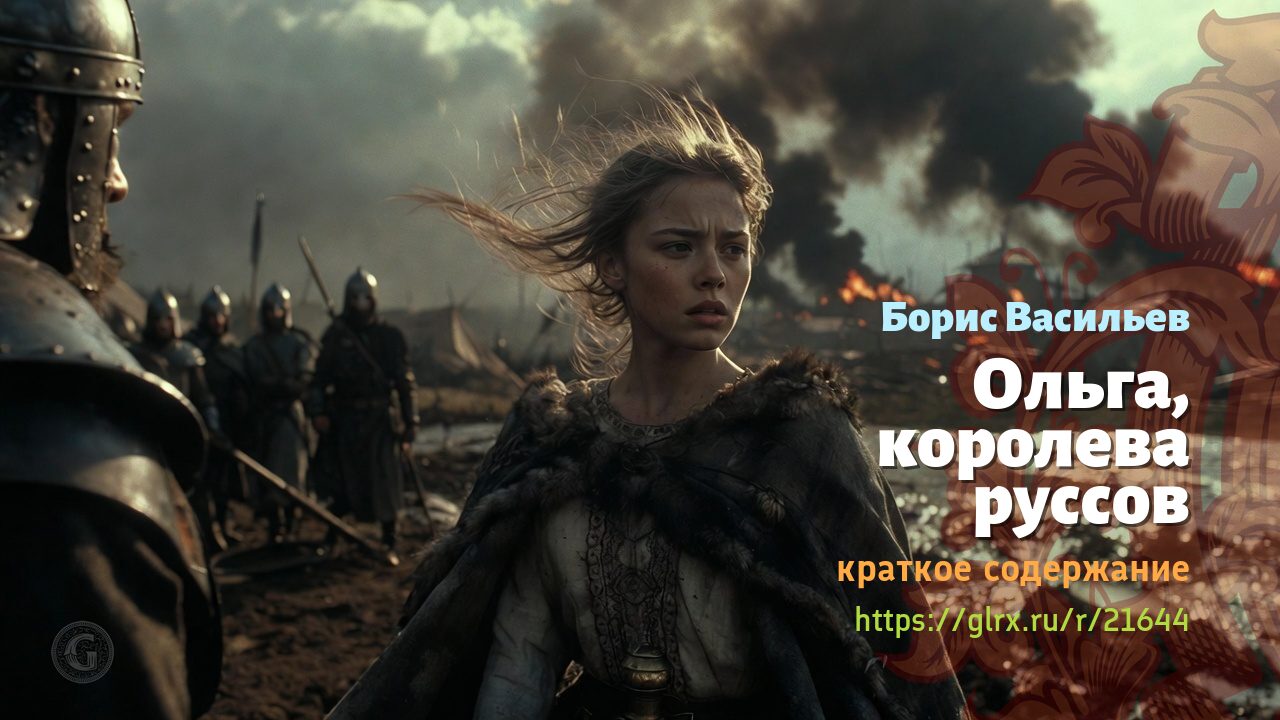
Olga’s youth and Igor’s power
Olga grows up in Pleskov under the care of Oleg’s men and, from an early age, becomes accustomed to restraint, danger, and the thought of her princely duty. Oleg marries her to Igor, Rurik’s son, because this marriage is intended to strengthen Kyiv’s power and link the family union to political considerations.
After Oleg’s death, power passed to Igor, but he inherited neither his firmness nor his foresight. Igor waged war, marched on Byzantium, and tried to hold on to his lands, but his decisions often proved weak, and Kyiv’s position remained precarious. Against this backdrop, Olga became increasingly involved in the affairs of the principality, demonstrating intelligence, fortitude, and an ability to see beyond the custom of the warriors.
The death of Igor
The turning point comes during the Polyudye, when Igor, having already received tribute from the Drevlyans, decides to return for more plunder with a small retinue. This decision is born of greed and overconfidence and quickly leads to disaster. The Drevlyan prince Mal and his men revolt, attack Igor’s detachment at Iskorosten, destroy the retinue, and execute the prince himself in a cruel manner.
Olga, left a widow by the young age of Svyatoslav, immediately realized that this was not just a personal tragedy but a direct challenge to Kyivan authority. The Drevlians sent ambassadors to Kyiv and offered her Mal’s hand in marriage, hoping to subjugate Rus’ through this marriage. From this point on, Olga no longer acted as a grieving wife, but as a ruler who needed to respond in a way that would return fear of Kyiv to all her subject lands.
Olga’s revenge and the structure of Rus’
Olga’s response is structured as a cold and consistent reprisal. She orders the first ambassadors to be carried with honor in a boat, then throws them into a pit and buries them alive. She orders the second, more distinguished delegation locked in a bathhouse and burned.
Then Olga herself rides to the Drevlians, ostensibly for a funeral feast for Igor. During the funeral feast, when the hosts lose their guard, her retinue kills many Drevlians. But even this isn’t enough, for she no longer seeks a sudden burst of vengeance, but the complete suppression of the rebellious land.
The siege of Iskorosten drags on, and then Olga resorts to cunning. She demands a seemingly light tribute — a few pigeons and sparrows from each household. When smoldering tinder is tied to the birds’ legs, they fly to their nests, and the city erupts in flames in many places at once. With the fall of Iskorosten, the Drevlyan land is broken, and the princess’s vengeance is complete.
Having defeated the Drevlians, Olga draws a political conclusion from Igor’s death. She changes the very procedure for collecting tribute, introduces "urok" (lessons), or fixed payment amounts, and establishes "pogosts" (counties), where tribute is collected according to established procedures. Personal tours of the lands for plunder are replaced by a more stable administrative structure, and princely authority becomes stricter and more disciplined.
Olga personally tours her estates, ensures orders are carried out, builds strongholds of power, and strengthens the outskirts’ ties with Kyiv. The novel portrays her as a ruler who combines rigor with prudence and understands that a state is held together not by military force alone, but by constant order.
Constantinople and Baptism
The next major milestone was Olga’s journey to Constantinople. She was preoccupied with trade, diplomacy, and Rus’’s place among the great powers. In Constantinople, she was baptized and given the name Helena.
This step is presented as a mature decision, one that harmonizes Olga’s personal experience, her view of power, and her vision for the country’s future. Baptism brings her closer to the Christian world, but at home she faces resistance from Svyatoslav, who refuses to renounce paganism and fears losing the respect of his retinue. A profound rift arises between mother and son over their very understanding of what Rus’ should be and the basis of princely power.
Svyatoslav and the finale
Having come of age, Svyatoslav assumed the throne, but remained first and foremost a warrior. He was drawn to campaigns, open combat, and military glory, while peaceful governance of Kiev seemed a burden to him. While he was at war, Olga maintained internal order and prevented the state from weakening completely.
Svyatoslav crushes the Khazar Khaganate, wages war on the Danube, clashes with Bulgaria and Byzantium, and dreams of moving the center of his dominion to Pereyaslavets. For him, this place is associated with wealth and power, but Olga sees his plans as a danger to Kyiv. Her experience tells her that a prince who strays too far from his land leaves it defenseless.
These fears are confirmed when the Pechenegs besiege Kyiv. Olga remains in the city with her grandchildren and endures a difficult trial until Svyatoslav returns. This episode particularly clearly illustrates the difference between them: the son seeks victory from without, while the mother saves the state from within.
After the siege, Olga’s strength fades, and she soon dies. Her death is perceived as the end of an era, for with it passes away a person who held in her hands the memory of old Rus’, political calculation, and inner fortitude.
Svyatoslav, left without his maternal counterweight, plunged into war even more decisively. He divided the lands among his sons — Yaropolk, Oleg, and Vladimir — and once again turned to Danubian affairs. The war with Byzantium did not end as he had hoped, and he was forced to make peace with Emperor John Tzimiskes.
On his way back, Svyatoslav is ambushed by the Pechenegs at the Dnieper rapids and dies. Khan Kurya orders his skull made into a cup of wine, and this final touch underscores the cruelty of the times in which the novel’s heroes live. The final lines connect the story to future generations through the fates of those in the prince’s entourage and through the memories preserved in the chronicle.
You cannot comment Why?