A summary of "The Widow’s Cloak" by Boris Akunin
 Automatic translate
The collection was written in 2016. The text is divided into two independent historical stories. Both stories describe the fates of two Russian rulers — Ivan III and Ivan IV — and their brutal methods of governing the country. The book won the prestigious OZON.ru ONLINE AWARDS literary prize for best fiction.
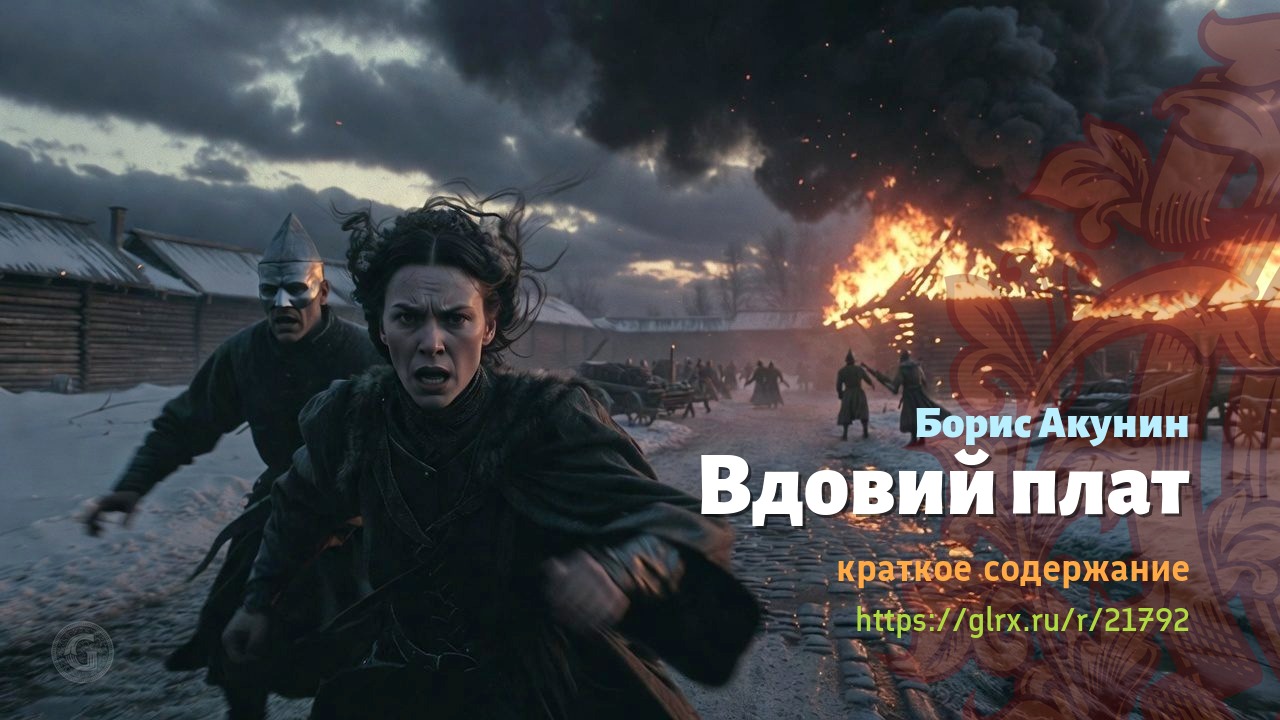
The work is considered the third volume of the large-scale project “The History of the Russian State in Stories and Novels.”
Widow’s kerchief
The events unfold in the 1470s. Grand Prince Ivan Vasilyevich of Moscow arrives with a huge army at the borders of Novgorod the Great. The ruler desires to completely subjugate the rich and free republic. The Muscovites set up a military camp near the city walls.
Within Novgorod, power is tacitly shared between three wealthy and influential women. Popularly, they are known as the "great wives." Nastasya Grigorieva, nicknamed "Stone," relies on Slavic merchants and controls grain supplies. Marfa Boretskaya, known as "Iron," dominates the minds of the Nerevsky residents and openly calls for war with Moscow. Efimiya Gorshenina, known as "Silk," weaves cunning intrigues and is not openly hostile to anyone. The women hate each other fiercely.
Ivan Vasilyevich receives the Novgorod boyars in a guesthouse. The prince accuses the republic of treason and secret ties with Lithuania. On his orders, the guards immediately arrest the staid posadnik (mayor) Vasily Ananyin and Marfa Boretskaya’s brother. The city is left without an official ruler. New elections are called. Alarmed, the women gather for a privy council. They vow to forget old grievances for the sake of defeating the Moscow prince.
Election struggle
Marfa Zheleznaya proposes a strong candidate, Anikita Ananyin, for the post of mayor. He advocates a strong military alliance with Pskov against Moscow. Nastasya Kamennaya decides to secretly thwart her rival. On the boyar’s orders, servants lure the boyar Yaroslav Bulavin’s father and wife to an abandoned mill. Yaroslav discovers the relatives together and, in a fit of rage, kills them both for adultery.
Nastasya promises to save the boyar from a painful execution in exchange for complete obedience. She then stages a false attack on Bulavin. Clever people spread rumors throughout the city that the boyar’s family was massacred by the Pskovites. Blinded by anger, the Novgorodians are filled with genuine sympathy for Bulavin. Nastasya makes this fierce and dim-witted warrior her candidate in the elections.
Boyarynya Kamennaya isn’t fighting alone. She is loyally served by Izosim, a frightening man in a silver mask who lost his face after being tortured in Moscow captivity. Izosim gathers rumors and coldly eliminates those who displease him. However, the stern servant suddenly falls in love with a young Lithuanian girl, Vita. This attachment proves fatal. On the eve of the elections, Izosim is found dead in his lover’s room. A bronze pin is buried deep in his throat.
Having lost her best spy and protector, Nastasya loses control of the situation. Efimiya Gorshenina betrays her ally and joins forces with Marfa Boretskaya. The enemies discover Kamennaya’s weakness. Boretskaya’s men suddenly capture Nastasya’s only son, the mentally disabled Yurasha, and his pregnant wife, Olena. They lock the captives in a forest hunting lodge and mercilessly set it on fire.
Nastasya arrives at the scene, engages in a fight, kills the leader of the kidnappers, Korelsha, and throws herself into the fire. She manages to save Olena, but Yurasha perishes in the flames. The pregnant daughter-in-law loudly vows revenge on her mother-in-law for the death of her beloved husband.
Betrayal
Having lost her son, Nastasya secretly visits the Moscow prince in his Kremlin chambers. She offers the ruler a lucrative deal. Nastasya promises to arrange matters so that at the great assembly, the Novgorodians will officially name Ivan Vasilyevich "sovereign." Such an address legally deprives the republic of all its ancient liberties and forever places the city under the complete control of Moscow. In exchange, Kamennaya asks to be appointed sole governor.
Ivan Vasilyevich happily agrees. The prince fervently praises the boyarina’s political acumen. Alone, the ruler confides his true plans to his loyal servant, Semyon Borisov. The Grand Duke intends to use the greedy Nastasya to completely destroy the Novgorod elite. Afterward, he plans to brutally deal with Kamennaya herself, and forcibly resettle all freedom-loving Novgorodians to remote Moscow provinces.
The Mark of Cain
The second part of the book takes the reader forward a century. The story is told from the perspective of Ivan IV, who is in the Alexandrovskaya Sloboda. The Tsar’s oprichnina court resembles a well-fortified monastery. The Tsar calls himself the abbot and his bloody oprichniki the black brethren.
The Tsar suffers greatly from physical pain, constant insomnia, and fits of uncontrollable rage. During one such fit, he kills his loyal servant, Fyodorets, with a dagger. The Tsar is constantly surrounded by loyal oprichniks led by Malyuta Skuratov. Ivan recalls his past cruel amusements. He proudly recounts how he forced the young Fyodor Basmanov to kill his own father to save his life. Ivan won a bet with Malyuta Skuratov, proving that savage fear is stronger than familial love. These memories soothe the monarch’s bruised pride.
Ivan Vasilyevich seeks justification for his monstrous atrocities. He considers himself an instrument of God, sent to earth to cleanse Rus’ of its deep filth. The ruler descends into a damp dungeon to the elder Cornelius the Cave-Dweller. This holy man is completely unafraid of the autocrat and openly despises the tsar.
Cornelius calls Ivan Cain to his face for the long-ago, treacherous murder of his cousin, Vladimir Staritsky. The elder loudly prophesies that the royal line will inevitably die out unless the sovereign finds himself a similarly accursed "Cain." These accusatory words deeply wound the soul of the superstitious monarch.
Seeking solace
The righteous man’s words greatly frighten the autocrat. The Tsar descends into the Torture Prison to see the country’s most heinous criminals. This is his old and tried-and-true method of consolation: seeing these insane maniacs, Ivan feels like a true righteous man.
The clerks show him a mad cannibal-chopper and a mad woman who has slashed Christ’s face with a knife. The Tsar orders the blasphemer to be horribly executed. The ruler solemnly pardons the cannibal and kisses him on the lips, reveling in his own false mercy before the Lord.
The third prisoner turns out to be a young Novgorod girl named Irina. She has committed a rare double murder — she mercilessly stabbed her own father, a priest. The girl boldly and utterly fearlessly looks the all-powerful Tsar in the eye. Irina recounts how her greedy father tried to sell her for the amusement of a sadistic oprichnik. The Tsar, in a fit of savage rage, grabs the defiant prisoner by the throat. In self-defense, Irina knees the Tsar hard in the groin.
The illusion of love
The guards quickly subdue the dangerous criminal. Her short hair falls from her face. The Tsar sees a round, pink birthmark on Irina’s high forehead. A similar mark — the mark of long prostrations on the stone floor — now glows on Ivan’s own forehead. In a frenzy, the Tsar takes this as a sure sign from above. He decides that the very same "Cainite" stands before him.
Overcome by sudden passion, the Tsar orders Irina’s immediate release. He solemnly promises to make her the great Russian Tsarina. The Tsar leads the young girl into his luxurious chambers, boastfully showing her his countless treasures, gold watches, and foreign talking parrot.
In the bedroom, Ivan Vasilyevich lies down on the bed and obediently allows Irina to tie him tightly to the carved wooden posts. He voluntarily gives her the royal tamga — a gold plaque with a double-headed eagle, before which all palace doors obediently open.
Having received the coveted seal, Irina deftly gags the Tsar. The girl quickly leaves, promising to escape forever into the deep Russian forests. Ivan remains firmly bound to his own bed. The great Tsar is plunged into complete solitude and pitch darkness.
You cannot comment Why?