A summary of "Adolescence" by Anna Starobinets
 Automatic translate
"Adolescence" is Anna Starobinets’s debut collection, published in 2005. In it, everyday life, childhood fears, family quarrels, and urban mundanity quickly veer into the realm of body horror and disturbing fantasy. This book is notable for the fact that almost all of the most terrifying events stem not from rare catastrophes, but from everyday life — school grievances, a cramped apartment, a train ride, illness, loneliness, and family breakdown.
In 2013, the story of the same name from this collection was awarded the Spanish Premios Nocte prize, which brought the book and its author significant international recognition in the horror genre.
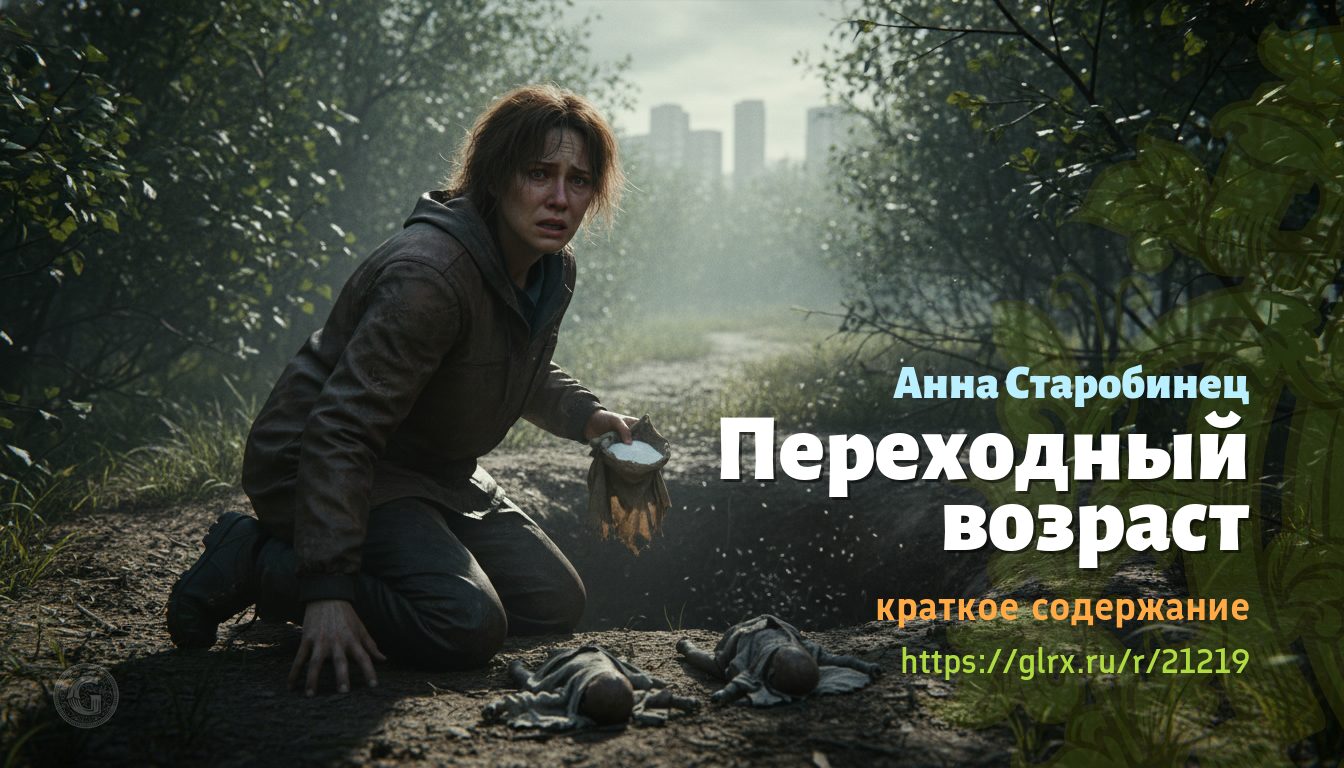
The story "Adolescence"
The book’s central theme begins with Marina’s recollection of the last good day in her family’s life: she’s walking through the forest in Yasenevo with her twins, Maxim and Vika, while birds swoop low around her, as if sensing trouble ahead. Even then, Maxim tells his mother he doesn’t like this place, a remark that later takes on a darker meaning.
Marina lives alone, the children grow up nearby, but a sharp rift quickly develops between them. Vika remains thin, active, and observant, while Maxim becomes increasingly withdrawn, rude, and begins to instill an almost animalistic fear in those around him. When he’s ten, the school is alarmed by his strange behavior: he takes away a weak classmate’s lunches and threatens to strangle him and bury him in the woods.
By the age of twelve, the changes are undeniable. Maxim is rapidly gaining weight, barely bathing, his room is filled with a foul odor, and Vika insists that insects are crawling on his bed and even on her brother himself. Marina doesn’t want to acknowledge the depth of the problem: it’s easier for her to think that her son is simply going through a difficult time, and that her daughter is exaggerating and jealous.
The family life is also crumbling at this time. The man who tried to become close to Marina almost disappears from their lives; his mother grows tired, irritated, and stops noticing the distinct, alien order that has taken hold in Maxim’s room. The boy eats sugar, honey, and sweets in alarming quantities, hides his food, lives in his own stench, and increasingly seems less and less like someone who can be brought back by a simple conversation or care.
What makes this story particularly terrifying is "Maxim’s Diary," where at first we hear the voice of an ordinary child — boastful, resentful, attached to his father, and hostile to his sister. Gradually, the mistakes, incoherence, and childish speech begin to convey not just naivety, but an internal disintegration of personality: an alien will awakens within the boy, and his body and mind become the environment for another being. Through these entries, we see how everyday horror slowly evolves into a biological nightmare.
Vika’s storyline runs alongside this mutation and highlights it. The girl grows up, tries to live a normal teenage life, thinks about her appearance, school, and her place among her peers, but the house is already infected with something that leaves her with no normal future. While Marina hopes for explanations that fit within conventional logic, the family’s troubles mature as a real, physical process.
The finale shifts the action to a forest burrow, where Marina finds her children already dead — their empty, stiff shells lie before her. Nearby are newborn creatures, a boy and a girl, and ants scurry around them, keeping their mother from getting too close. Marina carries out the bodies of Maxim and Vika, buries the dead baby, and from that day on, she carries sugar into the forest every day, because she cannot stop considering these monsters her children.
Stories
In the story "The Living," a woman agrees to the technological return of her deceased husband. A huge aquarium containing a special solution is brought into the apartment, and the heroine watches as the man she once loved is regrown from his remains. The tension is built on the discrepancy between hope and revulsion: technically, the husband is returning, but the very possibility of such a return proves more terrifying than death.
"Family" begins with an almost mundane scene: Dima stumbles onto a train at the last minute and falls asleep in an empty compartment. Then the reality of the train becomes unstable: a disabled man appears next to him, his head open, from which he pulls out grapes and food, and the journey descends deeper and deeper into a vile, absurd, and frightening waking dream. Here, the ordinary journey becomes a trap, where the presence of strange bodies and voices destroys the hero’s sense of normality.
In "Agency," the protagonist follows a muddy path between sheds covered in slime and excrement toward a mysterious institution that is supposed to solve his problems. Instead of clarity, he finds himself in a world of humiliation, dull bureaucracy, and hidden threat, where a person quickly ceases to be an individual and is reduced to a function. The story is built on the clash of everyday poverty with a faceless authority that seems almost infernal.
"The Crack" unfolds inside an apartment, where a father peers briefly at his young daughter playing on the carpet. From this calm domestic scene, horror emerges: a crack opens in the family’s world, through which something alien and dangerous begins to seep into the familiar space. The story’s power lies in the fact that the threat emerges not from outside, but right within the home, where the person is confident of the child’s safety.
In "Rules," a boy named Sasha walks down the street and obsessively follows a set order: he counts, steps over cracks, and watches his right and left feet, certain that a mistake will lead to disaster. Gradually, this childhood ritual takes over the entire world around him, and the asphalt, cracks, steps, and random obstacles transform into a rigorous system of tests. The story accurately conveys how fear creates its own mechanics and how a child becomes a prisoner of his own way of defending himself.
"Yasha’s Eternity" begins with an illness that initially seems almost normal: weakness, aches, a slight fever, early awakening. Then Yasha discovers that changes are occurring not at the level of his well-being, but at the level of the very nature of his body and life. The story leads the hero to a state where personal time, flesh, and consciousness cease to obey human norms, and the word "eternity" sounds not like consolation, but like a sentence.
The most grotesque and, at the same time, most pitiful story in the collection is "I’m Waiting." Its protagonist tells of a creature that grew in his home from forgotten food: he loves it, hides it, renounces work and people for its sake, and then watches helplessly as those who arrive in gas masks destroy it with chemicals. After this loss, he begins to wait again for a new life to be born, this time from baked apples covered in white fluff, and this final hope makes his madness final.
You cannot comment Why?