"Eyes of the Earth:
Ship’s Thicket" by Mikhail Prishvin, summary
 Automatic translate
This book is a synthesis of two late works by Mikhail Prishvin: a collection of philosophical and poetic diary entries, "Eyes of the Earth," written between 1946 and 1950, and the fairy tale novella "Ship Thicket," written between 1952 and 1953. The novella was the writer’s last completed work, published in 1954, after his death. It is a direct continuation of the famous 1945 fairy tale "The Pantry of the Sun," and once again features the beloved orphaned brother and sister, Nastya and Mitrasha Vesyolkin, the old forester Antipych, and other residents of the Yaroslavl region.
Philosophical Diaries "Eyes of the Earth"
The collection consists of the writer’s reflections on nature, artistic creativity, aging, and the human soul. In the first part, "The Road to a Friend," Prishvin describes purchasing a house in Dunino in 1946, observing the changing seasons, growing trees, and mushroom picking expeditions, and talks about his mother and his dog, Zhulka. The author shows how, through sensitive attention to the world around us, we overcome personal grievances and loneliness, paving the way for others.
The "Reflections" section is devoted to understanding art and the artist’s behavior. The writer formulates the idea that poetry is an act of friendship with the reader. A true master spiritualizes the world, revealing the beautiful sides of the human soul through observations of birds, flowers, and forests. Prishvin compares his worldview with the legacy of Leo Tolstoy, Anton Chekhov, Sergei Aksakov, and Mikhail Lermontov, championing the idea of human immortality through creative work.
In the sections "My Fellow Countrymen" and "The Life of a Tree," the author describes the habits of domestic animals — the cats Vaska and Domna Ivanovna, the dogs Zhulka, Norka, Kado, and Djali, and the puppy Domby. In the life of the forest, the writer is fascinated by the constant struggle of trees for light. A mighty spruce or a young pine are presented as living beings, maintaining dignity and striving upward.
The diary concludes with the collection "Seasons," which traces the natural calendar from January to December, and the reflections "The Mirror of Man." Prishvin argued that in nature, man sees his own reflection, and the purpose of culture is to preserve and enhance harmony.
The fairy tale "The Ship’s Thicket"
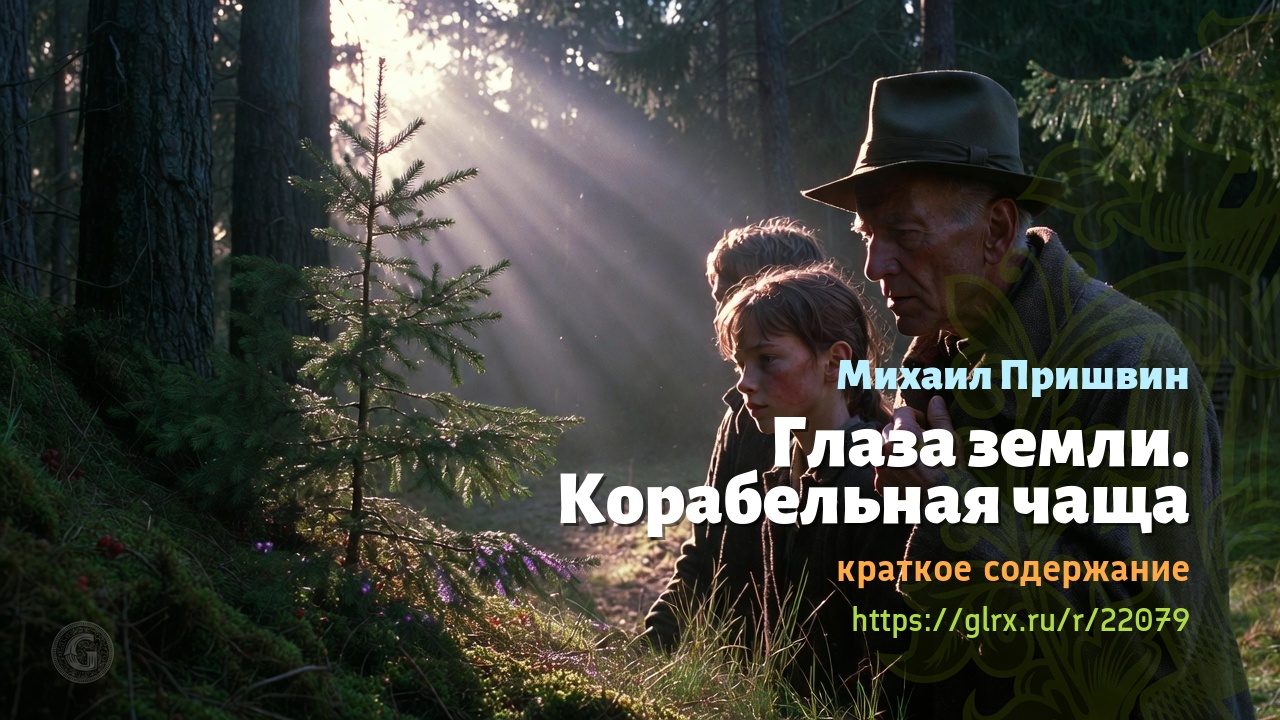
The story takes place in the village of Usolye near Pereslavl-Zalessky and the northern forests. In the early years of Soviet rule, a boy named Vasya Vesyolkin finds a small, weak fir tree in the Vederki tract, its growth hampered by the shadow of an old pine tree. Vasya persuades the old forester, Antipych, not to cut down the little tree. Antipych agrees and tells the boy a legend about the remote, protected Korabelnaya Thicket in Komi, where centuries-old pines stand so close together that a felled tree does not fall, but instead rests on its neighbors.
Years pass. The old pine tree falls, and sunlight breaks through to the clearing. "Vasya’s little tree" rearranges its shady needles, overcomes illness, and transforms into a tall, slender beauty, blooming purple cones dusted with golden pollen. Vasya grows up, becomes a forester, marries Liza, and they have children — Nastya and Mitrasha.
The Great Patriotic War begins. Vasily goes to the front, where he soon receives a funeral notice. His mother, Liza, succumbs to grief and dies, leaving Nastya and Mitrasha orphans. The children courageously run the household. Mitrasha kills the dangerous wolf "Grey Landowner," and Nastya gives her entire supply of medicinal cranberries to the evacuated children of Leningrad.
Unexpectedly, a letter arrives in Usolye, written in his father’s left hand. It turns out that Vasily has survived a serious injury; his right hand is bandaged and barely functional, but he’s alive. He’s been tasked with searching the north for high-quality wood for aircraft plywood. The letter doesn’t include an exact address — only the postmark "Pinega" is visible. Nastya and Mitrasha decide to set out to find their father. Schoolteacher Ivan Ivanovich Fokin supports their plan and sends the orphans on their way.
Meanwhile, events unfold in the field hospital. The wounded Vasily Vesyolkin lies next to the giant Pomor hunter Manuylo from the northern village of Zhuravli. Manuylo tells Vasily about his hunting route with the "Wolf’s Tooth" sign, his dispute with the "Bednyak" collective farm, and the sacred Korabelnaya (Ship Grove) thicket. Vasily advises Manuylo to go to Moscow to Mikhail Ivanovich Kalinin for justice. Vasily himself saves his arm from amputation: he proves to the doctor that with his two functioning fingers, he can roll a cigarette from a calendar sheet. On this sheet, he reads a quote from Belinsky about Russia’s calling to speak a new word of truth to the world. Vasily sets off for the North as a searcher for ship timber.
Nastya and Mitrasha arrive in Vologda. Policeman Shuryonok introduces them to his uncle Manuylo, who had already visited Moscow. Kalinin allowed the hunter to keep the fishing route and advised him to rename the collective farm from "Bednyak" to "Bogach." Manuylo takes the children on his log raft, a "pike," and sails them down the Vologda River to the Sukhona.
Vologda hunters gather in the lowlands near Vygor Hill: ninety-three-year-old master Silych with an antique "Krynka" rifle, the inseparable cook brothers — blind Pavel and deaf Pyotr, and hunters Zhuravel and Long Chukok. They set off for the Krasnye Grivy wood grouse mating ground, but discover the protected pine forest has been felled. Wood grouse are singing right on the freshly cut stumps. The shocked hunters are unable to raise their guns against the defenseless birds.
A violent spring flood begins. Manuila is recruited to save a log barrier — a zapon — on the Verkhnyaya Toyma. The children remain at the river exchange in Nizhnyaya Toyma, where they learn their father has gone deep into the taiga narrows toward the Koda and Loda rivers. Nastya and Mitrasha follow him through the impenetrable taiga, navigating by boundary posts and tree notches.
Manuylo returns to his native Zhuravli, where the collective farmers accept Kalinin’s advice, rename the artel "Bogach," and give the hunter two sacks of flour. Manuylo takes the supplies to his own trail, to the camp hut. However, a hungry bear breaks into his barn, carries off the sack, and dies in a steel noose. Seeing the dead animal’s flour-stained nose, Manuylo feels pity and realizes he can’t live isolated on his own trail; it’s time to help others. Realizing that the children walking along the trail are his friend Vasily’s family, Manuylo rushes to their rescue.
The children cross the narrows, passing through llamas and marshy surady, listening to the sounds of the night forest. They reach the Three Mountains river terrace, where the highest peak is home to the protected Ship’s Thicket, maintained by the old watchman Onisim.
Vasily Vesyolkin is already there. He’s brought a team of young workers who have already begun tapping pine trees for aircraft plywood. At that moment, Onisim and Manuilo ascend the mountain. They bring good news: the Great Patriotic War has ended in victory. There’s no longer any need to destroy the protected grove. Manuilo relays Kalinin’s legacy that the ancient forests must be preserved for the future.
Nastya and Mitrasha run out into the clearing and hug their father. Vasily Vesyolkin calls off the felling and orders the cuts on the pine trees to be covered with healing plaster. The protected Korabelnaya Thicket is saved.
You cannot comment Why?