"In the Land of Fearless Birds" by Mikhail Prishvin, summary
 Automatic translate
Mikhail Prishvin’s "In the Land of Unafraid Birds" is a series of travel essays written in 1907 following the author’s trip to the Vygovsky region of the Olonetsk province and supplemented in 1908 by a second part, "For the Magic Kolobok." The author depicted the northern landscape, combining ethnographic observations of the folklore, beliefs, and crafts of the inhabitants with philosophical reflections on the place of humans in the natural world.
For these essays and collected folklore materials, the writer was awarded the Small Silver Medal of the Imperial Russian Geographical Society in 1910 and elected as its full member.
The work is included in the author’s collected works and traditionally opens the first volume of his lyric and prose works, marking the beginning of the northern cycle.
The road to the Olonetsk province and the Vygovsky region
Wanting to escape the bustle of the city and the contrasts of modern civilization, the author departs St. Petersburg for the North. Armed with an open letter from the Academy of Sciences to collect ethnographic data, he sails on the new steamship "Pavel" across Lake Ladoga, the Svir River, and Lake Onega to Petrozavodsk and Povenets. Along the way, the writer observes the passengers, converses with merchants and clergy, notes monuments from the era of Peter the Great, and visits the secluded Clement Monastery on the Onega River.
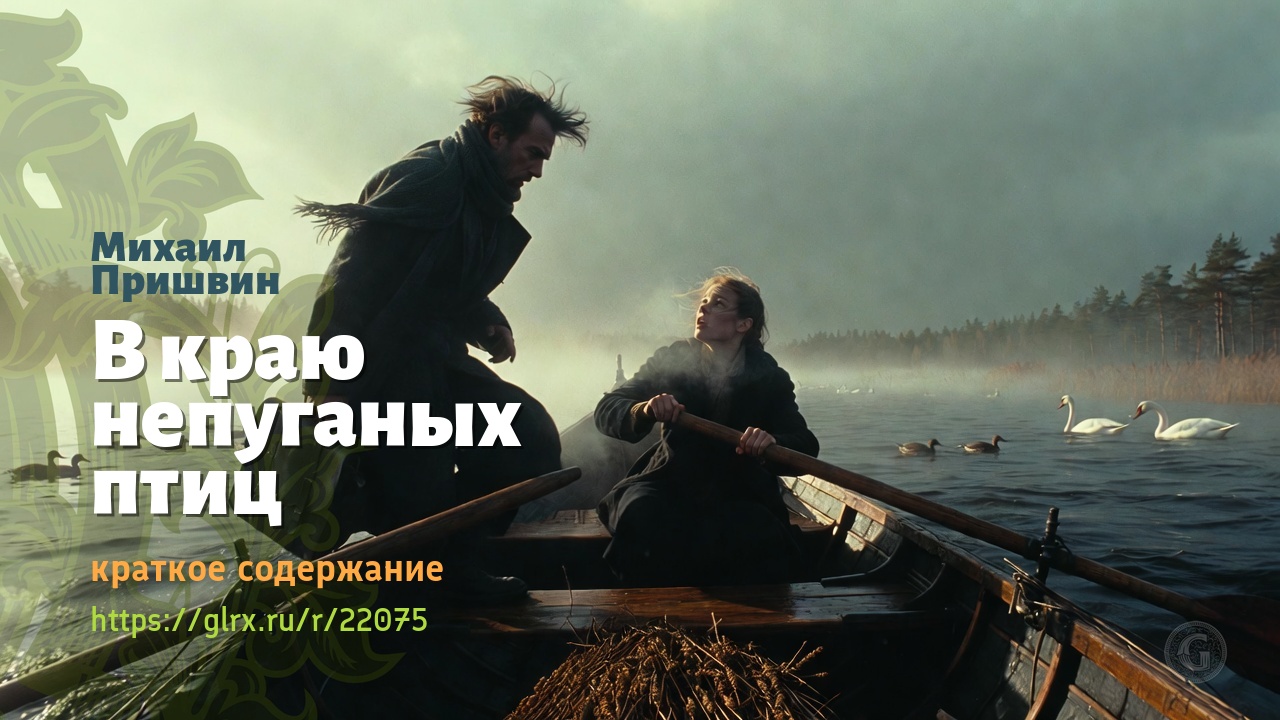
After passing Povenets and the Maselga Ridge — the watershed between the Baltic and White Sea basins — the traveler, accompanied by local rowing women, sails along Lake Vygozero in a boat sewn together with heather rods. The author stops on Karelsky Island. On Lake Vygozero, birds — swans and ducks — live unafraid, as locals consider shooting them a sin. The locals preserve legends of buried treasures and the "lords" (or "pans") of the Time of Troubles, whom the peasant Koiko killed in the Voitsky Falls. The writer explores the Voitsky Falls and, from Spruce Island, observes the salmon run, and also recalls the history of the Voitsky copper and gold mines.
Life of the Vygozersk people and folk poetry
On Karelian Island, the traveler meets the wailer Stepanida Maksimovna. She recounts her difficult life: her birth in the harvest field, her love-marriage to Gavrila, her wedding ceremonies (hand-shaking, "beautification," bride-selling, unbraiding), and the difficult life of a large family in a single hut. Stepanida recalls the quarrels between the daughters-in-law over the "six spoons" during the division of property and the subsequent death of her husband in the lake. After the spirit of her husband, who had floated away, appeared, Stepanida became a professional mourner, conveying the spirit of ancient Slavic lamentations.
The Vygov people’s daily life is filled with constant labor. In the spring, a significant portion of the population goes to work as "barge haulers" — a dangerous rafting expedition down the rivers to Soroka, from where the timber is shipped to England. Others fish for pike with nets, transport cattle by boat to the islands, and in the summer, they mow marsh stubble in mosquito nets with pink salmon and dry birch leaves for cow feed. In the fall, the Vygov people catch whitefish and vendace with seine nets and sell the fish to the "rich" or take them to the fair in Shunga. In the forest huts ("faterki"), the storyteller Manuilo tells the workers tales of the peasant king in the evenings.
On a separate island, the author meets the epic storyteller Grigory Andrianov, who manually clears and burns burnt fields in the forest, teaches his sons, and sincerely believes in the truth of the heroic tales of Ilya Muromets and Dobrynya Nikitich.
Foresters, sorcerers and the schismatic region
Forest hunters live in the forest villages of Pulozero and Khizhozero. Guide Philip shows Prishvin "power trails," snares for black grouse and wood grouse, and tells him about escapes from ravens and encounters with bears in the thicket. The foresters hunt squirrels and wood grouse with Karelian Laikas, and in winter, they stalk moose and deer on the frozen crust, spending the night around a forest fire called "nudya."
The locals firmly believe in wood goblins ("Shishko"), water spirits, and sorcerers. The author meets the blind sorcerer Mikulaich Ferezeiin on Korosozero, who "washes" guns in the lake and "releases" (charms) cattle from wild animals, as well as his rival, the sorcerer Maksimka, who sends bears to attack the herds.
The Vygovsky region is closely linked to the history of the Old Believers. The author describes the history of the Danilov community (Vygovskaya Pustyn), founded in 1695 by Danila Vikulich and the Denisov brothers. The community endured the "frozen years" of poor harvests, baked bread from pine bark, paved roads (including Peter the Great’s "Tsar’s Road" in 1702), and built workshops, schools, and libraries. In 1857, the government of Nicholas I destroyed the monasteries. The memory of the schism is preserved by Lyubov Stepanovna Egorova and her son Ivan Fyodorovich on Karelsky Island.
On the edge of the forests live the skreshchniki (wanderers) — followers of Euthymius’s teachings, fleeing the state and denying passports. Prishvin is staying in Pulozero with the skreshchniki and Christ-loving Mukha (Alexei), the owner of a large house and an expert on ancient books and the Solovetsky petition.
A trip to the ocean and Lapland
The second part ("For the Magic Kolobok") is dedicated to a 1907 trip. The idea of the "magic kolobok" leads the author from Arkhangelsk across the White Sea. In Krasnye Gory, the author boards a mail boat with a crew (the helmsman, Stepan "the Peasant with a Fingernail," Ivanushka the Fool) and sails to the village of Durakovo. There, the peasants mistake the traveler for a "member of the Duma for the photography section," give him salmon, and ask him to divide up the sea bass.
On the shores of the White Sea, the author meets an old Yurovshchik (yur-driver) who transports pilgrims to the Solovetsky Islands. The Yurovshchik recounts his thirty-year hunt for seals on ice floes, his three-month adrift in the ocean, and his rescue by the Samoyeds in the Timan Tundra. At the Solovetsky Monastery, the author observes the pilgrims’ daily life and talks with monks and a former deacon-bartender.
The journey then leads through Kandalaksha, the Niva River, and the mountain lake Imandra to Lapland. Vasily, a Lapp, and his family take the author by boat across the clear waters of Imandra. On Deer Island, the traveler spends the night in a tezha (a wooden hut) and kuvaksa (a wooden hut), plays cards with the Lapps, and listens to their tales. In the Khibiny Mountains, in the Im-Yegor Gorge, the author observes the never-setting sun.
In the ocean and on the Norwegian coast
From Arkhangelsk, the author sets out to sea on the fishing trawler "Saint Nicholas," under the command of a young captain. On Kanina Shoal, the sailors trawl hundreds of pounds of cod, haddock, halibut, wolffish, and deep-sea sharks. The author battles seasickness with a Vologda cook, watches fulmars, and Matvey hunt a killer whale. Through the fog, the ship passes sailboats and the long-awaited "Grand Duchess Olga."
Off the Murmansk coast, the author ascends to a fishing camp and converses with the Pomor Zveroboy, who magically dictates a newspaper article about the "physical strength" of officials, the colonist Vichurn, and the sage Ignatius. Here he observes a storm ("moryanka") and the harsh customs of the Pomors. Then, via Kildin Island, where the "King of Kildin" reigns supreme, and the bureaucratic town of Aleksandrovsk, the author sails to Norway.
In the Norwegian town of Vardø, the traveler passes under an arch of dried cod, dines with a Pomor named Pyotr Petrovich, and gets a haircut from a photographer-musician. Sailing past the cliffs of Nordkapp and Nordkyn with their bird colonies, the author arrives in Hammerfest and then visits Lingenfjord, discussing Bjørnson and Ibsen with students. Returning via Stockholm, the author experiences the first dark night with stars in his hotel room and realizes that his journey to find the magic bun has come to an end.
You cannot comment Why?