A summary of Mikhail Prishvin’s "A Tale of Truth"
 Automatic translate
"A Tale of Truth" is a collection of works by Mikhail Prishvin, compiled by his wife, Valeria Prishvina, and published in 1973 to commemorate the writer’s centenary. The collection contains excerpts from autobiographical novels, short stories, diaries, and essays written between 1905 and 1954. The core of the narrative is the search for spiritual truth, a kinship with humanity, and harmony with one’s surroundings.
The book was published in 1973 by Molodaya Gvardiya as part of the "On Your Road, Romantic" series. This series brings together classic Russian and Soviet works of fiction aimed at young readers.
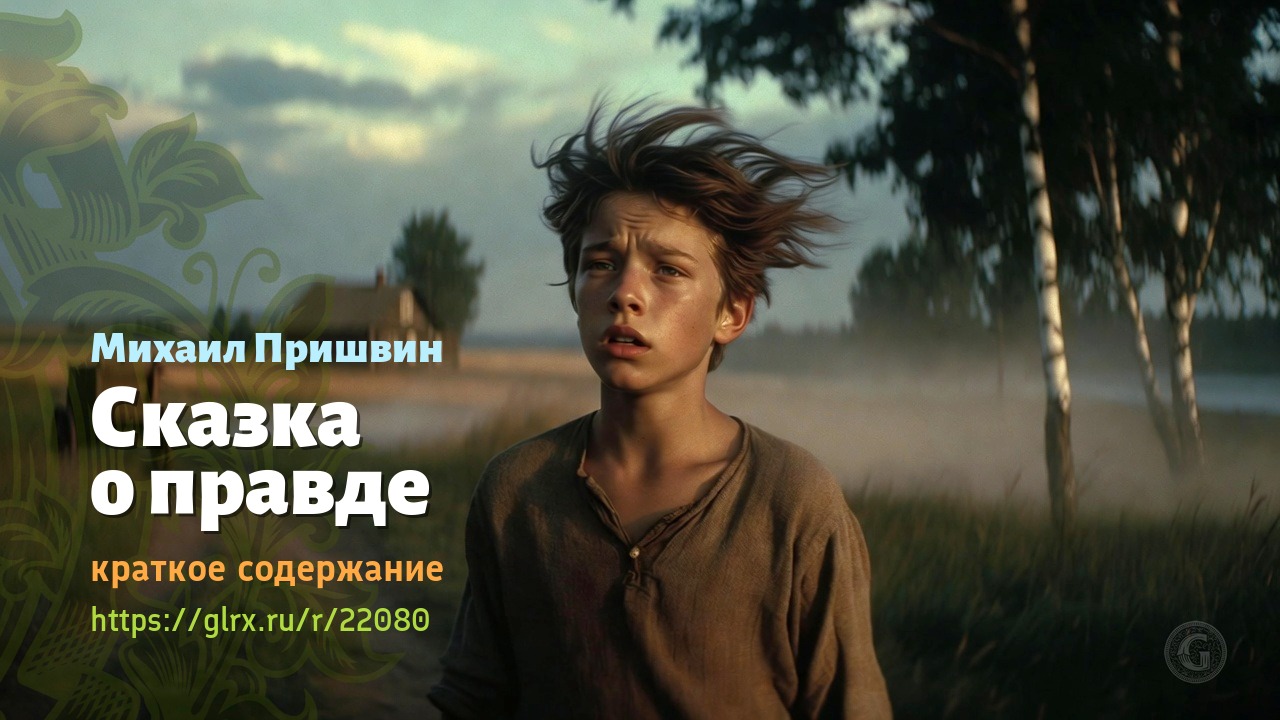
The author’s creative legacy has won widespread recognition. His novellas and short stories have been translated into foreign languages numerous times.
Kurymushka’s childhood and a fairytale struggle
The plot begins with excerpts from the autobiographical novel "Kashchei’s Chain." Little Kurymushka grows up on the Khrushchevo estate in the Oryol province. The boy’s father lost the estate at cards and died early, leaving his mother with five children. His mother, Maria Ivanovna, labors daily to pay off the bank and buy back the land. Kurymushka’s childish imagination transforms life’s hardships and human vices into fairy-tale figures. Real evil appears to him in the form of the Big Blue or Kashchei the Deathless.
Kurymushka observes the people around her, each of whom has their own secret. Aunt Dunechka shares the revolutionary ideas of her brother, nicknamed Garibaldi. The neighboring landowner, Sofia Alexandrovna, patiently endures her husband’s antics and obeys the church elder in everything. A simple peasant, Gusyok, dreams of catching a white merchant’s quail so he can strike it rich and buy a Tula samovar. A boy is tormented by petty secrets, like a stolen dried pear or the priest’s goose killed by his brothers.
Liberation from fears occurs after meeting Marya Morevna. The guest, a young girl named Masha, seems like a fairytale heroine to Kurymushka. At night, the boy comes to her bedroom and reveals all his fears. Marya Morevna promises to always protect him and never give in to Koshchei. Conquering his nighttime fears grants the boy peace of mind.
Travels through the North and Kazakh steppes
The hero sets off on a journey to the Russian North in search of a magic gingerbread man. The essays "In Search of the Magic Gingerbread Man" describe the journey along the White Sea coast to the Solovetsky Islands. In the Pomor village of Durakovo, the author meets the locals and records their tales and songs. He joins the peasants on sea fishing expeditions, observing the salmon and beluga whale fisheries.
In the story "The Black Arab," the action shifts to 1909, to the arid steppes of Kazakhstan. A traveler travels in a cart with his translator, Isak, disguised as a silent Arab from Mecca. Word of a mysterious horseman precedes his companions, giving rise to steppe mirages and legends among the nomads.
The author observes the daily life of nomadic villages, the rituals of the Muslim month of Ramadan, and the harsh natural environment. In the steppes, nomads herd their flocks, hunt wild argali sheep, and train golden eagles. The journey ends with the bai of Kulja, a wealthy steppe king who owns vast herds of horses.
Nature observation and hunting
In the 1920s and 1930s, the writer lived in the forested areas near Pereslavl-Zalessky and Zagorsk. His "Nature’s Calendar" cycle and hunting stories chronicle the changing seasons. The spring of light begins with a drizzle and the lengthening of the days, giving way to the spring of water, green grass, and forest.
Hunting serves as the author’s means of intimate communication with the forest and its animals. The story "Romka’s Training" describes a young pointer puppy’s first encounter with a rolling brick. The story "Anchar" tells of a hound bought from a poor peasant in exchange for a cow. While hunting, the author’s friend accidentally kills Anchar, mistaking his movement in the bushes for an owl.
The story "Winter" describes a winter fox hunt with the hound Nightingale. The dog dog doggedly pursues the red predator through snow-covered fields, burnt-out areas, and swamps. The hunter follows the tracks in the snow, overcoming the harsh frost and forest debris.
A Taiga Tale about the Root of Life
The story "Ginseng" takes place in the Far East, where the author traveled in 1931. After the war, a former soldier finds himself in a taiga ravine near the Pacific Ocean. He is taken in by an old Chinese man named Louwen, a seeker of the medicinal ginseng root.
In the taiga, the hero encounters sika deer. He manages to trap a graceful female Hualu and her calf at Cape Orlinoye Gnezdo. Together with Louven, they build a deer nursery to harvest the valuable antlers that preserve youthful vigor.
The hero learns from Louvain a kindred attention to every animal and flower. Later, in the taiga, they discover a young ginseng root resembling a human figure. The plant is left to grow, and the root becomes a symbol of spiritual rebirth, harmony, and the search for true love.
The Trials of War and the Rebirth of Love
The events of the Great Patriotic War are depicted in "A Tale of Our Time." The action takes place in a village near Moscow and the Yaroslavl forests. A local woman, Milochka, sees her husband Alexei off to the front. Later, she falls in love with a stuttering mechanic, Sergei, and develops a deep connection with him.
Some time later, an exhausted and emaciated Alexei returns from the front. Milochka offers warmth to her ex-husband, while her new beau, Sergei, helps her care for the returning soldier. The conflict is resolved by the heroes’ generosity: Alexei understands Milochka’s feelings for Sergei and leaves to rebuild the devastated cities.
In the story "The Blue Dragonfly," a wounded young soldier on the bank of a stream regains his will to live by watching an insect fly over the water. Mutual support between people and the beauty of nature help overcome any adversity of war.
Canal construction and diary thoughts
The final sections of the book contain excerpts from the novel "The Tsar’s Road" and the diary entries "Forget-me-nots." The novel describes the construction of the White Sea-Baltic Canal in the north. A boy named Zuyok, who has wandered away from people, finds himself on a plavina — a peat island torn away by the water, along with wild animals.
The steamship "Chekist" rescues a boy and attaches a rope to a swamp filled with animals. At the canal’s grand opening, Zuyok operates the spillway and releases the rescued animals. Man’s triumph over the elements unites those involved in the construction.
The collection concludes with the section "Forget-Me-Nots," composed of the author’s short notes from 1905 to 1954. The writer reflects on the meaning of words, death, childhood, and the eternal connection between man and the world. He defines poetry as an act of friendship and love for every living being.
You cannot comment Why?