A summary of Ivan Bunin’s "Cursed Days"
 Automatic translate
This book is the writer’s diary entries, written in 1918 and 1919. The author chronicles the collapse of the state daily through the prism of his personal perception of the catastrophe. The text was written at the epicenter of relentless terror, often in secret. Papers containing the diaries had to be hidden in narrow crevices in cornices or buried in the ground for the sake of their own lives.
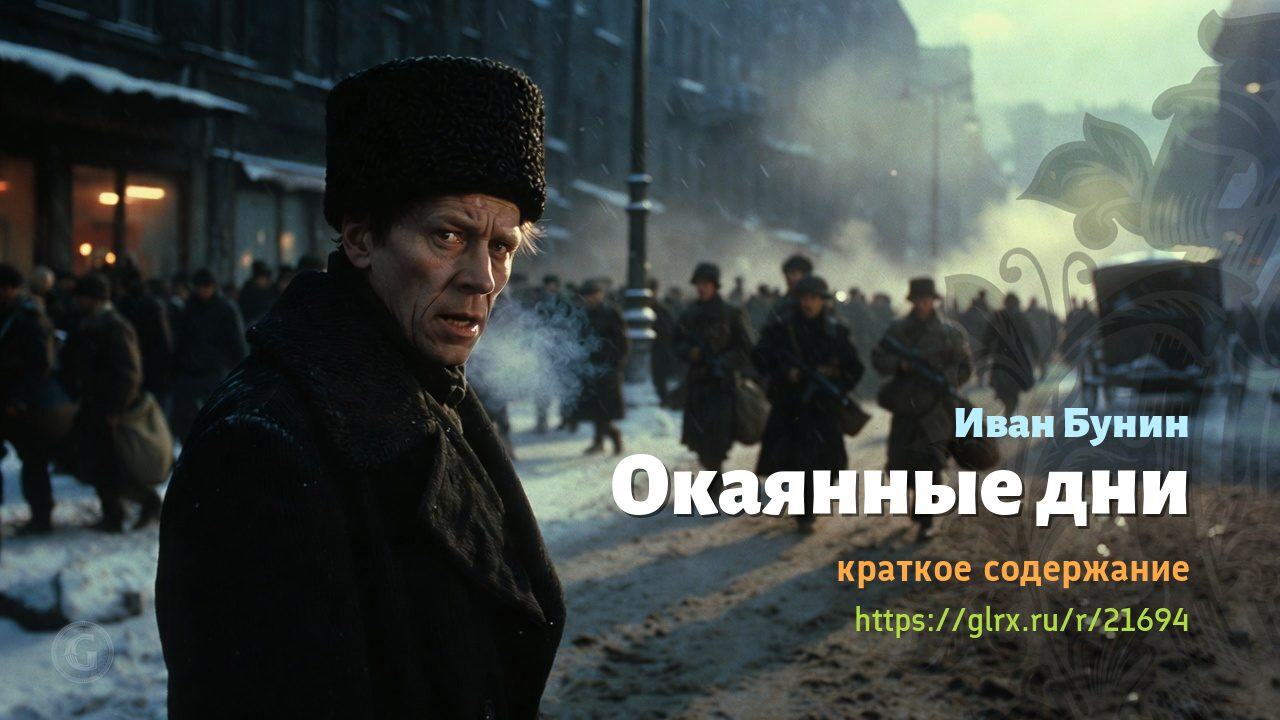
Moscow winter
The author finds himself in Moscow at the beginning of 1918. The Constituent Assembly is violently dispersed, and a new calendar is officially introduced. Spontaneous rallies are constantly springing up in the streets. The writer observes heated debates between ordinary workers, soldiers, and formerly wealthy individuals. The soldiers are suspicious and gloomy. The workers often display open disdain for the timid complaints of the intelligentsia. A nervous anticipation of the arrival of German troops hangs in the air. Many Muscovites openly hope that the foreigners will quickly restore order. Newspapers daily report brazen robberies, bloody lynchings, and murders. Peasants in Tambov villages murder suspected thieves without trial. Thieves are brutally smashed in the head with heavy steelyards and their sides ripped open with iron pitchforks.
The writer notes with great bitterness the rapid decline of human dignity. Old acquaintances come to visit and, without the slightest hesitation, devour the masters’ meager supplies of bread. The servants’ habitual behavior changes dramatically. Brother Julius’s servant, Andrei, who had served faithfully for almost twenty years, now makes no secret of his fierce anger toward his former masters. He openly threatens them with bloody reprisals. The very appearance of the streets changes. No one clears the snow, impassable mud and huge puddles are everywhere, and crowds of armed deserters wander about with canvas sacks. Formerly wealthy citizens and aging military generals trade at intersections or stand modestly, like beggars. People have surrendered surprisingly quickly, lost heart, and weakly submitted to circumstances.
Attitude towards writers
The author is particularly indignant at the conformist stance of the creative elite. Alexander Blok openly supports the Bolsheviks and voluntarily becomes Anatoly Lunacharsky’s personal secretary. Vladimir Mayakovsky, aptly nicknamed "Idiot Polifemovich" in high school, maintains a defiant, boorish independence. Valery Bryusov, a former ardent jingoist, swiftly changes his political views to please the victors. Maxim Gorky openly calls the new government a company of dangerous adventurers, yet his inner circle feels quite confident, brazenly occupying the best rooms in requisitioned hotels.
Bunin recalls a telling episode from April 1917 in St. Petersburg. At a gala banquet honoring Finnish artists, Mayakovsky began unceremoniously eating from other people’s plates. Then, with a wild, guttural roar, he deliberately drowned out the French ambassador’s toast. The entire vast hall instantly succumbed to mass psychosis, frantically kicking their boots against the floor. For the author, this bizarre incident became a clear symbol of the coming triumph of street buffoons. Literature was corrupted by uncontrollable crowds and the animalistic thirst for easy fame. Fashionable poets read their new works to speculators and prostitutes in the most vile taverns like the "Musical Snuffbox."
A shameful peace treaty with Germany is signed. The city is plunged into thick darkness, and the sound of frantic gunfire is constantly heard at night. Magnificent historic mansions are requisitioned by anarchists, and expensive carpets and paintings are being removed en masse from private homes. Bunin hastily raises money for his departure south, selling off his vast library for next to nothing. Life in Moscow becomes physically unbearable. The episode of the street funeral is etched in memory forever. When an armed sailor curses and disperses the quiet funeral procession, a random old woman passing by confesses sincerely, uttering through tears: "Stranger… I envy you…"
Odessa under Bolshevik rule
In the spring of 1919, the writer is in Odessa. French and Greek troops suddenly, without warning, abandon the city. The panicked flight of the former allies leaves civilians to be torn to pieces. Ataman Grigoriev’s troops noisily enter the city. They are bandy-legged teenagers, closely followed by hardened convicts. The streets quickly empty, the townspeople frozen with animal fear. A long era of terror and a relentless, grueling wait for rescue begins. People eagerly seize on any absurd rumor. They heatedly discuss the capture of Petrograd by the Finns, the advance of Generals Denikin or Kolchak, and the arrival of a mythical Japanese landing force.
Odessa is deprived of electricity, fresh water, and food. Grocery stores are closed, and prices for the meager supplies reach fantastic levels. At night, the port city is plunged into a sepulchral darkness. Only the ominous pink stars of the requisitioned buildings, where emergency commissions meet around the clock, glow transparently. Cars carrying dressed-up prostitutes, drunken sailors, and cocaine addicts race through the dark streets. A writer is forced to read by a stinking kitchen stove, rigorously saving the meager remains of oil. Long lists of citizens executed without trial are published daily. Murders in the emergency commission have become routine. People are shot right over ordinary toilet bowls. Visiting Baltic sailors murder innocent prisoners for drunken amusement, not sparing even infants.
Psychology of the Crowd and Revolution
Carefully observing the events, the author deeply analyzes the Russian national character. He clearly identifies two opposing types within the people: the creative Rus’ and the destructive Chud’. The sudden revolution awakened the most ancient instincts of mass destruction, the thirst for the illegal appropriation of others’ property, and primal cruelty. For decades, the Russian intelligentsia blindly idealized the people, completely ignorant of their true, extremely dual nature. Fine talk about universal equality and brotherhood predictably turned into a bloody farce.
The May Day celebrations evoke intense physical revulsion. The monumental statue of Catherine is cynically draped in dirty rags and thickly plastered with red wooden stars. Ludicrously painted chariots slowly drive along the central streets, staging the invincible might of the working class. At the port, Red Army soldiers senselessly chop down Odessa’s famous wooden overpass for firewood. Soldiers easily break off the butts of their rifles to quickly light fires. Brutal anti-Jewish pogroms regularly break out in the working-class suburbs. Crowds revel in smashing small shops, killing small traders and Red commissars, all under the guise of lofty slogans about an uncompromising struggle against global capital.
Information vacuum and newspaper lies
Everyday life is accompanied by the obligatory, painful reading of Soviet newspapers. The author buys them daily, as if deliberately torturing his own shattered psyche. The newspaper language is terrifying with its phenomenal stylistic flatness, incredible mendacity, and pompous, vulgar jargon. Editorials are replete with ferocious threats. Authors insistently call for the crushing and execution of all opponents, and for the bloodshed of overthrown thrones to be stained. Trotsky, Lunacharsky, and Lenin are hailed as the great saviors of humanity. Their numerous opponents are referred to exclusively as savage Huns, predators, and executioners. The Bolsheviks forcibly introduce a new, simplified spelling, which Bunin categorically refuses to accept.
Word of mouth remains the only available source of hope for the frightened townspeople. Acquaintances secretly whisper of mass peasant uprisings, of imminent powerful Allied landings, of the inevitable collapse of ignorant commissars. The writer describes with exquisite precision the state of mass, severe psychosis. An exhausted man falls asleep with a fervent prayer for God’s just judgment, awakens in a cold sweat from a nearby nighttime firefight, and early in the morning is once again confronted with the depressing reality of empty streets and brazen patrols. Far away in the deserted roadstead, a lonely French destroyer looms, instilling a fragile, illusory hope of armed defense.
Humiliation of everyday life
Armed squads regularly break into the surviving apartments of city residents to measure their living space and forcibly compact the bourgeoisie. Red Army soldiers brutally confiscate good mattresses, trunks, and warm winter clothing. House committees are led by completely random, uneducated individuals, constantly trembling with fear before the all-powerful revolutionary tribunals. Former literary acquaintances adapt surprisingly quickly and easily to the new, harsh reality. The renowned poet Maximilian Voloshin volunteers to decorate the streets for a proletarian holiday and sincerely admires the spirit of the local Cheka chief. The writer Alexander Fyodorov lamented the illegal requisition of a small country house built through years of hard labor.
The crowds on the streets radically change their usual appearance. Simple, respectable faces vanish forever. Their place is firmly taken by insolent faces with smoking cigarettes in their teeth, clad in ridiculous, dirty, rags. Drunken Red Army soldiers wear museum-quality uniforms from the 1970s, interspersed with bright red leggings and heavy antique sabers. Armed patrols openly rob random passersby, brazenly snatching pocket watches right in front of everyone. Women from formerly intelligent families are forced to carry heavy buckets of water from the port due to the city’s completely destroyed water supply. A wretched, impoverished trade flourishes everywhere. In filthy bazaars, people sit right on the manure, unsuccessfully trying to sell the rotten remains of vegetables and old rags.
Historical parallels
The diary’s pages are replete with direct comparisons of current tragic events with the difficult historical past. The author meticulously compares events with the Time of Troubles, the brutal, large-scale peasant revolt of Stepan Razin, and the bloody excesses of the French Revolution. The ignorant rebels of the past, who deliberately destroyed centuries-old culture and law, find their absolute counterpart in contemporary Bolshevik commissars. The French historian Le Nôtre, who describes in detail the insane atrocities of the paralyzed sadist Couthon, seems incredibly relevant to Bunin. The Moscow party leaders are in no way inferior to the Parisian executioners of old in their sophisticated, methodical bloodthirstiness.
The writer’s thoughts return to long, detailed conversations with peasants in the village of Vasilyevskoye during the hot summer of 1917. Even then, many wealthy peasants openly despised the weak temporary government and mocked the future Constituent Assembly, scornfully declaring, "What good would it do me to join it?" However, they eagerly took advantage of the ensuing impunity to commit wholesale, unbridled pogroms against neighboring estates. For a primitive amusement, the villagers cruelly plucked live peacocks, watching with wild laughter as they flail bloodily about the yard. These painful, graphic memories reinforce the author’s firm conviction that the revolution served only as the most convenient pretext for the free expression of dark, destructive human instincts.
Premonition of the finale
By the summer of 1919, general nervous exhaustion reaches an absolute, critical point. The sudden, encouraging news of General Denikin’s capture of Kharkov evokes a veritable storm of genuine tears of joy. These brief, bright moments of happiness are all too quickly replaced by bitter, black disappointment after reading dry newspaper refutations. Odessa continues to endure day after day in a state of constant anxiety, complete lawlessness, and increasing famine. Bunin is acutely aware that he is rapidly perishing. The endless, maddening series of mass executions, outright daytime robberies, and deceitful propaganda rallies methodically and mercilessly burns away the human soul.
The only safe haven of peace is the occasional quiet walk in the completely deserted bishop’s garden and regular visits to the Orthodox church. The solemn church service, the calming splendor of ancient ritual, and the harmonious, harmonious choral singing contrast sharply, incredibly painfully, with the surrounding street filth. Within the cool, protective walls of the old church, the exhausted writer finds brief, timid solace. He becomes startlingly aware of the insurmountable, bottomless chasm between the quiet mercy of Christianity and the brutal, openly sadistic cruelty of the new regime.
The diary entries end abruptly and forever. In a short final postscript, the saddened author reveals the true reason for this interruption. The scribbled pages, continuing the harrowing chronicle, were buried too securely, too deeply, in the damp earth before his hasty escape from Red Odessa at the end of January 1920. The writer was never able to find them in the frozen ground before his forced departure for eternal exile.
You cannot comment Why?