"The Parsley Syndrome" by Dina Rubina, summary
 Automatic translate
This book, written in 2010, completes the acclaimed trilogy "People of the Air." The work deeply explores the creator’s fanatical devotion to his art. The author describes the puppeteer’s obsessive love for his wife. The woman’s serious illness becomes a severe test of their relationship. The novel is permeated with mysticism. Prague legends and old family secrets come to life in the text.
In 2015, the novel was successfully adapted into a film. The film of the same name, starring Yevgeny Mironov and Chulpan Khamatova, attracted widespread attention.
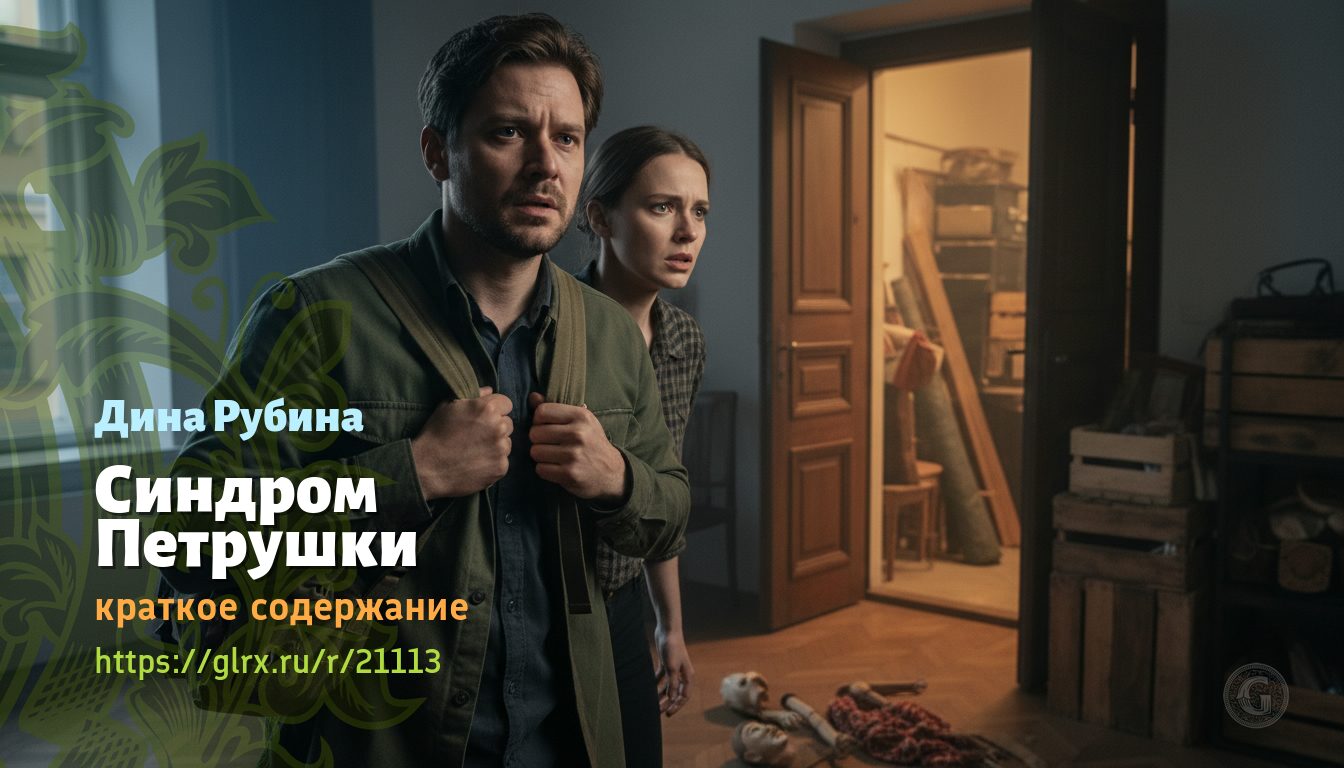
Returning from the clinic
The novel begins in Jerusalem. The protagonist, Petya Uksusov, picks up his wife, Lisa, from a psychiatric hospital. Her attending physician, Boris Gorelik, insists on treatment. He sees discharging her as a grave mistake. Petya takes his wife to Eilat to recuperate. Their relationship is complicated. Lisa hates her husband. She often loses her temper. Sometimes, Lisa gives in to her kind feelings. One night in Eilat, the couple quarrels. Lisa’s illness was caused by the death of their son. The boy suffered from a rare genetic disorder. Doctors call this condition "Petrushka syndrome." The sick child always laughed for no reason.
Soon, Liza’s Aunt Visya dies. The couple travels to Samara. There, they are met by family friend Silva Zhuseppovich Morelli. Silva helps them arrange their apartment. A lot of old things remain in his aunt’s house. Silva accidentally finds an abandoned doll in the basement. Petya instantly recognizes it as the Innkeeper. It’s an ancient family heirloom of the Vilkovskys, Liza’s ancestors. Petya secretly hides the wooden idol in his backpack.
The hero’s past
The story is frequently interrupted by Dr. Gorelik’s recollections. Boris meticulously analyzes his friend’s life. Petya grew up on Sakhalin in the town of Tomari. The family consisted of a border guard veteran, Romka, and his mother, Katya. His father had lost his right arm. The veteran was a master of left-handedness. Roman Petrovich had an incredible ability to bring objects to life. From an ordinary handkerchief, he created a running mouse. The boy inherited this gift. Petya always carried plasticine in his pocket. He sculpted tiny little people.
Petya’s fate was changed by an old Lviv puppeteer named Kazimir Matveevich. The master had arrived in the Far East after serving in the camps. He showed the boy a traditional hooligan in a red cap. The boy felt a physical kinship with Petrushka. Soon, Petya began visiting the master in Yuzhno-Sakhalinsk. The old man taught him the basics of the craft. He demonstrated the construction of the gapit — an internal rod for controlling the head. He instilled in his student great patience. Later, Petya’s father died in a drunken brawl. Enemies stabbed the veteran to death while he was dancing. Romka tap-danced and taunted his opponents.
Lviv secrets
Petya’s mother moved to Lviv. Ivana Franko, Zelena, and Shota Rustaveli Streets formed the triangle of Boris’s childhood. At the age of eight, Petya witnessed a terrifying scene. A young woman jumped out of a window onto the cobblestone street. The victim’s name was Yana Vilkovskaya. Soon after, the boy kidnapped one-year-old Liza from her stroller. Basya, a laundress, quickly returned Yana’s daughter home. From then on, the teenager’s life was inextricably linked with the red-haired child. He would visit her house and watch the child for hours.
Liza grew up under Petya’s strict supervision. He protected her from admirers. The young man forced the girl to study ballet, shaping her character. Liza’s father, Tadeusz Vilkovsky, was a cynical lawyer. He frightened the young man with his blatant immorality. One day, Petya realized something terrible: the lawyer harbored dark intentions for his own daughter. Petya brutally beat Vilkovsky. The young man took Liza from home forever. The fugitives left for Leningrad. Petya vowed to protect the girl from her dangerous relative.
Ellis’s Birth
Petya became a brilliant puppeteer. He created a dance routine for two. The couple became famous throughout Europe. The couple danced to the music of "Minor Swing." After the death of their sick child, Lisa flatly refused to perform. Having lost his partner, Petya created a unique puppet, Ellis. She became a mechanical replica of his wife. The artist equipped her with a complex system of hidden rods. The puppet moved using a special horizontal rod — a crosspiece with threads. An old glassblower from Brno blew Ellis’s eyes. The artist precisely replicated the honey-mustard color of Lisa’s irises. The mechanism allowed the puppet to breathe and glide smoothly across the parquet floor.
The appearance of an artificial double shattered Lisa’s psyche. She perceived Ellis as a living rival. His wife accused her husband of betrayal. He had chosen a meek piece of polymer over a living person. Trying to save his wife’s sanity, Petya hid Ellis in Prague. The Prochazok family, a family of hereditary dollmakers, became her guardian. Grandmother Hana kept the doll on a cabinet. There, Boris Gorelik one day saw the perfect figure of the mechanical girl.
The Innkeeper’s Curse
Wanting to unravel the Innkeeper’s secret, Petya comes to Berlin. Professor Vaclav Ratt tells his guest a sinister story. In the nineteenth century, a wandering puppeteer seduced the daughter of a Jewish innkeeper. The old man cursed the offender with an ancient ritual. The puppeteer married another woman. Their sons were born with laughing doll syndrome. The professor displays a collection of antique puppeteers.
Trying to reverse the curse, the craftsman consulted a fortune teller. She ordered a wooden effigy of the Innkeeper carved. The craftsman placed the crimson-haired figurine inside. The wooden idol worked flawlessly, producing healthy, red-haired daughters. However, the relic brought no peace. The women of the Vilkovsky family were doomed to tragedy.
Dr. Gorelik learns a shocking detail from Dr. Yakov Ziv. Tadeusz Wilkowski lost Yania to a Soviet officer in a card game. For the sake of her husband’s honor, the woman went to the winner. Returning in the early morning, she committed suicide. Yania’s younger sister stole the Innkeeper and fled to Samara. The fugitive, Visya, hoped to break the chain of family misfortunes.
Farewell dance
Before leaving Prague, Boris visits friends. The doctor accuses his friend of heartless selfishness. He persuades Petya to give his wife more freedom. Petya agrees to perform with Ellis at a Russian cabaret. Her dance with the mechanical woman mesmerizes the club’s patrons. Leaving the doll in the greenroom, Petya enters the auditorium. Meanwhile, Lisa sneaks backstage and secretly takes Ellis. A security guard mistakes the doll for a live performer. The kidnapper calmly walks out.
Returning home, the comrades witness a horrific scene. Liza is sitting in a chair. The severed head of the double lies across her lap. The artificial woman’s body has been hacked to pieces with a hammer and saw. Petya faints from grief. Liza announces to Boris the end of the story. The doll has served its purpose, all troubles are over. The couple decides to stay together. They are expecting the birth of a new healthy child. Boris returns to Jerusalem, relieved.
The epilogue transports the reader to the Charles Bridge in Prague. A cold spring wind blows through the stone vaults. The street musician Honza plays a recording of "Minor Swing." A puppeteer steps out onto the cobblestones. Petya dances without a puppet. A man gracefully twirls an invisible partner.
The audience watches the brilliant performer, mesmerized. His hands hold the precise memory of a woman. He performs a farewell dance for the deceased Ellis. The master releases his artificial love forever. The melody soars over the Vltava River. Petya mentally cuts the golden threads. He prepares to begin his life anew.
- "Petya, the wolf and Volodya the musician" 6+
- Prokofiev-Gala: two anniversaries on the stage of the Natalia Sats Theater
- "Winter Wind" by Valentin Kataev, summary
- "Catacombs" by Valentin Kataev, summary
- "The Lonely White Sail" by Valentin Kataev, summary
- "Fall in Love in 90 Seconds" by Asya Lavrinovich, summary
You cannot comment Why?