"Not All Is Shrovetide for the Cat" by Alexander Ostrovsky, summary
 Automatic translate
Alexander Ostrovsky’s play "Not All Is Shrovetide for the Cat," written in 1871 and titled "Scenes from Moscow Life," depicts an everyday conflict in which the old merchant autocracy clashes with the personal choices and dignity of the poor. The action centers on a seemingly simple, isolated case of matchmaking, but through it, Ostrovsky demonstrates that wealth no longer grants a person the same unconditional power over the fate of others.
The action begins in the modest but tidy room of merchant’s widow, Darya Fedoseyevna Kruglova, where she lives with her daughter, Agnia. From their initial conversations, it’s clear that the family is poor, lives frugally, and has few connections, so the question of Agnia’s marriage is a serious one for her mother. Agnia is young, beautiful, and lively, but her circle of acquaintances is small, and suitable suitors are almost nonexistent.
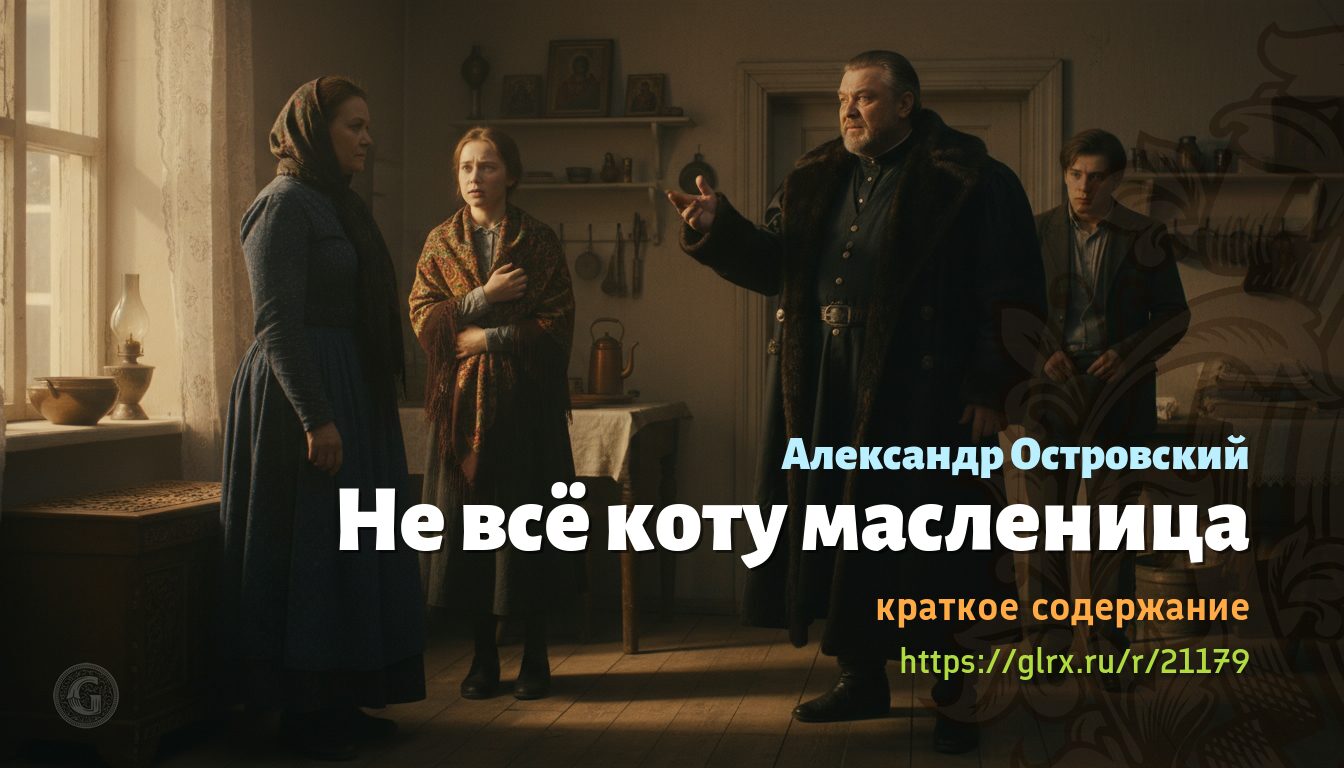
The conversation between mother and daughter immediately sets the moral tone of the play. Kruglova thinks about her daughter’s future in a practical, worldly way, but is unwilling to marry her off to a man who would humiliate her with his treatment. Agniya, for her part, speaks more freely and sharply: she finds it difficult to accept poverty and the monotony of life, but even more difficult to contemplate a marriage without love and respect.
Gradually, it becomes clear that a wealthy merchant, Yermil Zotych Akhov, has his sights set on Agnia. He’s already advanced in years, extremely self-assured, and accustomed to looking down on others. For him, his own money and position are sufficient grounds for counting on the obedience of those around him, and he views a future marriage as a bargain in which his wealth must outweigh the youth, feelings, and dignity of his bride.
Akhov’s liaison is with the clerk Ippolit, a young man of modest means and gentle nature. There is mutual attraction between him and Agnia, but Ippolit is too dependent on his master and too timid to immediately act openly and firmly. He loves Agnia, but at the beginning of the play, this love is entangled with fear, indecision, and a habit of deferring to a stronger person.
Agnia senses Ippolit’s affection, but she won’t accept halfhearted behavior. She doesn’t need a man who complains and hesitates, but a man who can state his intentions directly and defend them. Therefore, in conversations with Ippolit, she can be blunt, even mocking. These remarks hurt him, but behind them lies not coldness, but a demand for honesty and inner strength.
Ippolit wavers between love and dependence on Akhov. He understands that poverty makes his situation humiliating, and his service to a wealthy merchant has long since accustomed him to submissiveness. He possesses conscientiousness and kindness, but this is not enough: until he dares to speak with his own voice, he has no right to ask for Agnia’s hand. Ostrovsky guides his hero through this moral ordeal without outward pathos, through everyday scenes, brief remarks, and subtle but very precise shifts in tone.
When Akhov shows up at the Kruglovs’, his behavior finally reveals the essence of the conflict. He behaves like a man confident in his pre-purchased consent, and barely conceals his contempt for the poverty of his mistress and her daughter. His words convey the conviction that a young girl should be grateful for the mere attention of a rich man, and that a mother should bow to money and family ties.
Darya Fedoseyevna responds to Akhov calmly but firmly. She recognizes that their household is poor and that turning down a rich man could be costly, but agreeing to a humiliating marriage would mean ruining her daughter forever. Her moral position is simple: better is poverty and an honest life than satiety at the cost of shame. In this restrained firmness, Kruglova proves morally superior to the smug merchant.
Agniya is even bolder. She doesn’t hide her disgust at the calculated matchmaking and makes it clear that she doesn’t see Akhov as a suitor. She finds the very way he comes to fetch his bride humiliating, as if he’s already certain of everyone’s consent. The girl refuses to accept wealth as a sufficient basis for marriage, thereby breaking Akhov’s customary order, where the elder and richer are always right.
Against this backdrop, Ippolit experiences an internal transformation. The humiliation Akhov inflicts on Kruglova and Agnia affects him more than any previous conversation. He begins to see that silence makes him complicit in others’ rudeness, and that his love for Agnia demands action, not complaint. He resolves to break the bondage that has kept him in fear and robbed him of self-respect.
The final scene builds to a confrontation between Ippolit and Akhov. For the first time, the young clerk speaks firmly to his master, demands what is due him, and stops behaving like a man obliged to endure endless humiliation. This is significant not for its outward effect, but for its inner meaning: Ippolit wins the right to be with Agniya precisely at the moment when he stops trembling in the face of money and power.
Akhov cannot accept rejection or defeat. He is outraged that the poor are no longer willing to bow at his feet, unwilling to bow either for kinship or for money, and perceives this as the collapse of the old order. His long, angry speech reveals a man accustomed to considering his own will a natural law for everyone else. Now this law ceases to apply, and Akhov is left helpless before the dignity of others.
The play ends with Kruglova’s refusal to marry her daughter to a wealthy merchant and the union of Agnia and Ippolit. Darya Fedoseyevna’s final words — "Not all is Shrovetide for the cat, there is also Lent" — are addressed to Akhov and sum up the entire plot. The meaning of this denouement is clear: power based on money, rudeness, and the habit of submissiveness is not eternal, but a poor man who finds courage can defend both love and human honor.
- "Our Crimea" - a joint exhibition of Crimean and Kazan live-dog men opened in Kazan
- Exhibition "Transbaikal Classics: Yuri Kruglov, Vladimir Pinigin, Nikolai Polyansky"
- English painters
- A summary of Alexander Ostrovsky’s "Hard Days"
- A summary of Ivan Bunin’s "At the Source of Days"
- "Enough Stupidity in Every Wise Man" by Alexander Ostrovsky, summary
You cannot comment Why?