A summary of Viktor Astafyev’s "Pass"
 Automatic translate
This autobiographical story about a Siberian boy’s coming of age was written in 1958–1959. The work is distinguished by its harsh realism of taiga life and a profound psychological insight into the formation of a teenager’s character among ordinary workers. The author conveys the atmosphere of the grueling labor of log rafting workers without embellishment, depicting in detail the real life of a remote village in the 1930s. The events take place against the backdrop of the turbulent Mara River, where the wild nature constantly tests people’s limits.
In 1978, the work was adapted for the screen by director Bulat Mansurov at Mosfilm Studios. Released under the title "Seagulls Never Flew Here," the film accurately captured the mood of the original text.
Life in a forest village
The action takes place in the remote village of Shipichikha on the steep bank of the Mara River. The majority of the population consists of seasonal loggers living in a long, elongated barracks. The village comes to life only during haymaking season, when city students arrive. The rest of the time, life is monotonous. Ten-year-old Ilka Verstakov lives here with his hunter father, Pavel, his stepmother, Nastya, and his little half-brother, Mitka. Ilka’s biological mother drowned long ago. His stepmother is constantly irritated, quarreling with neighbors and taking out her anger on her stepson.
The boy’s father disappears for long periods into the remote taiga, hunting for meat for the lumberjacks. In his absence, Nastya throws fits, berates Ilka for his daily bread, and forces him to endlessly babysit the capricious Mitka. Ilka often recalls the difficult winter of the previous year, when his father was hospitalized. The family was starving. The boy had to chop firewood in the forest. One day, a dead larch tree fell on him, and he miraculously survived. Kind people from the village saved them from perishing, feeding them and helping them with firewood.
Tensions in the family have been building for months. One summer day, the stepmother starts another major argument, insulting Ilka’s late mother and his village grandparents. The boy treasures the memory of his mother. He remembers the scent of strawberries lingering in the hut on the day she died. In a fit of rage and deep resentment, Ilka throws a heavy hammer at Nastya, smashing her head until it bleeds.
Terrified by what he’d done, Ilka flees the hut through the vegetable garden, straight into a thicket of stinging nettles. After waiting out the commotion, he makes his way to the river and finds shelter in an abandoned hut on Verbny Island. The boy decides to live as a hermit. He subsists on handfuls of currants, potatoes baked in a fire, and gudgeon roasted on a spit. At night, Ilka suffers from a chilling fear of the dark, birdsong, and rustling sounds. During the day, he sneaks into the house to retrieve the pot and fishing rods his stepmother left on the windowsill.
Meeting with rafters
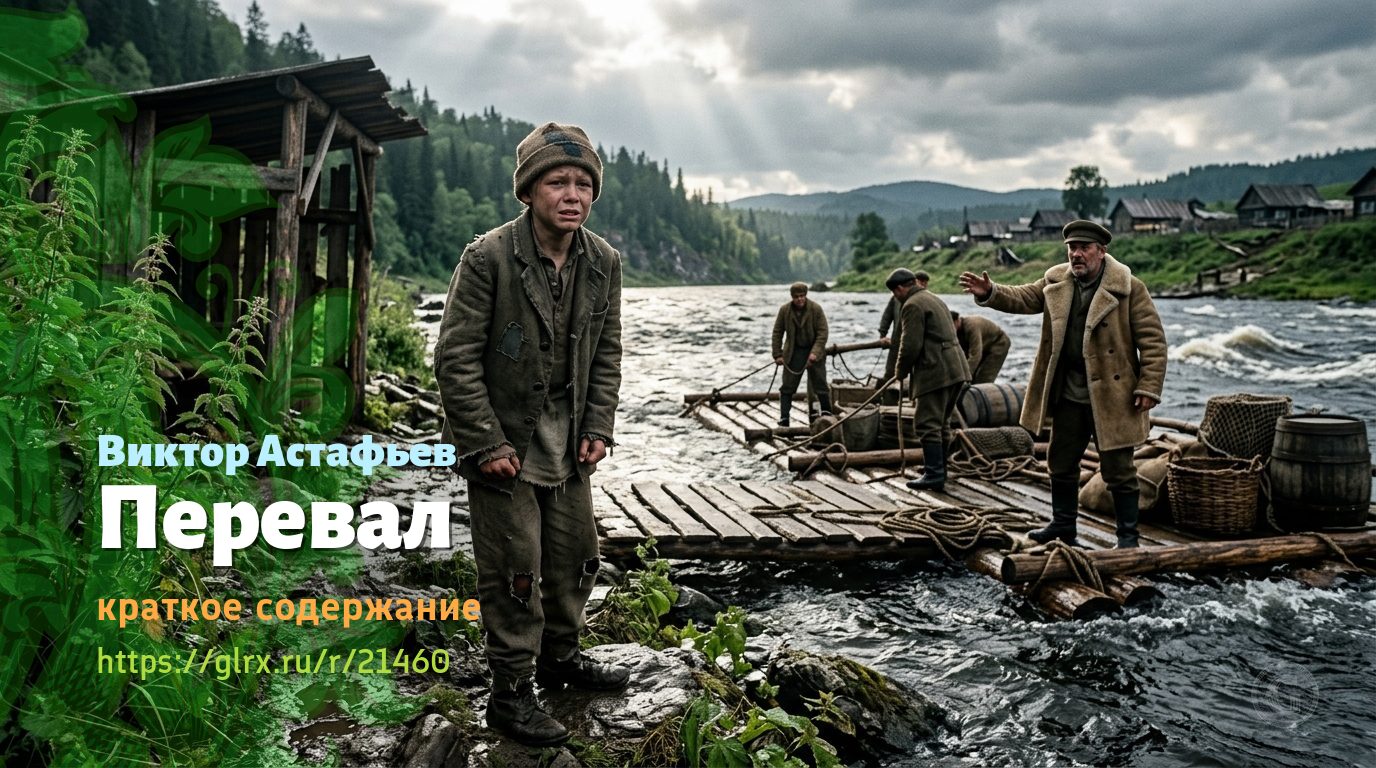
On the third day of their solitary life, a team of timber rafting workers lands at the island. They are traveling on a "kazenok" — a large log raft with a living quarters and a drying rack for work clothes. The team is led by the fair and strict foreman Trifon Letyaga. Working alongside him are the experienced vagabond Uncle Roman, the talkative former student Derikrup, the stingy and pious Isusik, the taciturn hereditary raftsman Skovorodnik, and two powerful lumberjack brothers, Gavrila and Azariy.
The stern men notice the hungry, feral Ilka and listen attentively to his story. They understand that the boy must absolutely not return to his wicked stepmother. Trifon Letyaga decides to take the boy with him to Ust-Mara. From there, Ilka will be able to reach his grandparents in the village of Uvaly. The rafters officially enroll the boy in their crew. Derikrup solemnly fills out the order, registering the boy as a proletarian.
The new worker is entrusted with serious responsibilities. Ilka must cook soup for the entire crew, keep the barracks tidy, and dry the workers’ wet canvas clothes at night in a hot dryer. The boy strives to live up to the team’s trust. He makes decoy flies from silk thread and bird feathers. Using these, he catches large grayling and cooks a rich fish soup for the men, exhausted from hard work. A shaggy little dog named Archimandrite, rescued from the water by the men, also lives on the raft. The dog becomes Ilka’s faithful companion during night shifts by the blazing stove.
Life on the raft goes on as usual. During the day, the lumberjacks risk their lives clearing the rocky banks of stuck logs. In the evenings, the men smoke strong homegrown tobacco and argue about everything under the sun: religion, illness, and politics. Derikrup talks a lot about distant Ukraine, where sweet fruits unknown to the boy grow. A student tries to teach the illiterate Ilka arithmetic and reading. Trifon Letyaga also tests the boy’s intelligence unexpectedly, forcing him to mentally calculate his tools.
Soon, a barge loaded with grain, sugar, and a mobile movie theater docks at the raft. The rafters are paid their overdue wages. That evening, they watch a silent comedy about a tramp right on the raft, roaring with laughter at the hero’s antics. After the barge departs, the men have their traditional party. They drink the vodka they bought and snack on wild onions and sausage. The tipsy lumberjacks sing a mournful song about a white seagull. Ilka listens to this sad, bone-chilling tune with tears in his eyes.
That night, a drunken brawl breaks out between the rowdy, lanky Gavrila and the cowardly Jesus. The foreman is forced to tie Gavrila’s hands and feet with strong ropes. In the morning, the men are suffering severely from hangovers. Uncle Roman complains to Ilka about his heart condition and the ruined lives he’s had. The men overcome their weakness and still go out to work. The postman, Prokhor, swims up to the treasury and hands Trifon a letter from the head of the office. He informs him that there will be no help, and the crew will have to deal with the wreckage alone.
The dangers of the Oznobikhinsky Pass
The team approaches the Oznobikhinsky Pass. This is the most forbidding and cursed place on the river. Here, the Mara is tightly hemmed in by high, bare cliffs bearing the marks of a terrible forest fire. The raging current lashes furiously against the rocky outcrops, and near the seething Revun Rapids, a gigantic pit of thousands of logs forms. The rafters, aided by Kambar boats, spend days hauling away the piled-up timber. The work is extremely difficult, and the men are exhausted.
Jesus, who out of greed refused to buy rubber boots, works in slippery leather overshoes. He slips on a wet larch trunk and falls into the icy water just before a rocky rapid. Trifon Letyaga rushes to save his drowning comrade. The foreman catches up with him, but they are no longer able to reach the shore. The wild current inexorably drags them straight onto the sharp rocks of Revun.
Trifon clings to the rocky outcrop with all his might, while Jesus, crazed with terror, panics and climbs onto it, beginning to drown his savior. The wounded foreman’s strength quickly fails. Ilka sees the disaster from the shore and leaps into a light dugout. The boy maneuvers on a pole between the rushing logs, swims to the rock, and snatches the drowning men just before their inevitable death.
Having survived the shock, the rafters continue their long battle with the Oznobikhinsky dam. Following the resourceful Skovorodnik’s plan, the men artificially block the riverbed with logs, creating a transverse dam. The river’s water rises rapidly. The accumulated mass breaks through the barrier and, with a cannon-like roar, carries the entire accumulated timber far downstream. The most dangerous pass has been successfully crossed. The crew celebrates a hard-won victory with relief.
The end of a difficult journey
The raft arrives safely at its final stop at Ust-Mara. The crew’s shift work is over, and they begin to dismantle the treasury. It’s time for Ilka to head over the mountain range to the village of Uvaly. The rafters give the boy a canvas work jacket and boots for growth. Trifon Letyaga issues Ilka his first real salary — 84 rubles 50 kopecks.
The men pool this money from their own meager savings, so as not to offend the boy with a handout and to hand it out officially, using a homemade receipt. Ilka thanks the workers with tears in his eyes. During the journey, he has become much stronger physically and mentally. The boy firmly learns the most important life lesson from his older mentors: in any difficult moment, you should stick close to good people.
- "War Thunders Somewhere" by Viktor Astafyev, summary
- Valery and Anastasia Polotnov presented their work in the hall of the Union of Artists with the exhibition "Look into the Present"
- Personal exhibition of Sergei Pisarev. To the anniversary of the author
- Exhibition of one painting by Jan van Goyen (1596 - 1656) "Fishing boat at the mouth of the river"
You cannot comment Why?