A summary of "Vasyutkino Lake" by Viktor Astafyev
 Automatic translate
This book is the story of a thirteen-year-old boy’s survival in the harsh Arctic taiga. Written in 1952, the plot is autobiographical and based on the writer’s real childhood experiences. The author himself got lost in the forest while picking cedar cones and spent several long days alone.
Autumn camp on the Yenisei
In the lower reaches of the Yenisei River, Grigory Afanasyevich Shadrin’s fishing crew is suffering setbacks. Frequent autumn rains have significantly raised the river’s water level, forcing the fish to sink deep to the bottom. Fishing is sluggish, and the fishermen are despondent and bored with idleness. Grandfather Afanasy grumbles that the Yenisei has become depleted, and the steamboats have scared away all the fish. The crew relocates to a new location and lodges in a dilapidated hut built several years ago by a scientific expedition. Grigory Afanasyevich, Vasutka’s father, orders the seines prepared for the large fish run. Fishing with set lines fails to bring the fishermen the excitement they expected.
Thirteen-year-old Vasyutka is bored out of his mind at the campsite. There are no friends for boisterous play, and nowhere to go. The boy eagerly awaits the start of the school year. Uncle Kolyada, the foreman of the fish-harvesting boat, has already brought him new textbooks from the city. During the day, the boy idly flips through the pages, and in the evenings, he listens to long fishermen’s tales. To please the adults, Vasyutka goes into the forest, hacking at nearby trees and collecting pine nuts.
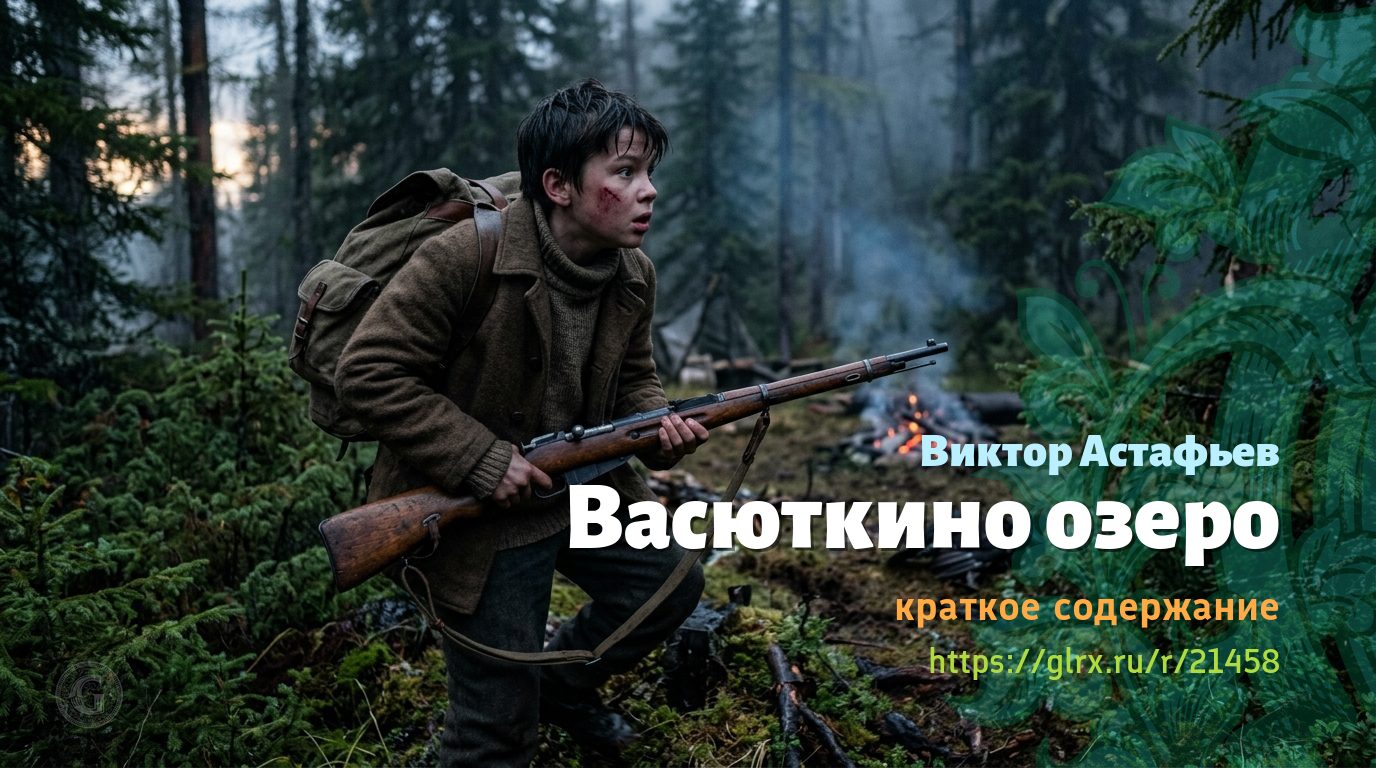
One day, he’s getting ready to go into the forest again. His mother tells him not to stray from the zatse — special forest notches on tree trunks. She forces him to take a crust of bread with him. Vasyutka reluctantly stuffs the food into his bag, takes his rifle and cartridge belt, and heads into the taiga. He follows signs, knocks resinous cones off cedars, and loudly scolds the annoying, noisy nutcrackers. Ahead of him, a large wood grouse flapped its wings heavily.
Fatal mistake
Captivated by the bird, the boy forgets all about caution. He recalls the stories of seasoned hunters, drops to all fours, and begins to imitate a dog’s bark to keep the curious prey in place. Vasyutka crawls through the damp moss, scratches his face, sneaks up closer, and shoots. The wood grouse is wounded and flees in short dashes deep into the forest. The hunter gives chase, shoots again, and falls upon the wounded bird.
Overjoyed at his catch, which weighed about five kilograms, he turned back toward the camp. Soon, the boy realized that the familiar notches were nowhere to be found. The forest looked alien and completely unfamiliar. Vasyutka tried to figure out the direction by the density of the branches, but quickly became confused. Panicking, he noticed a dead fly in an old spider web and suddenly realized the depth of his predicament. He broke into a run, smashed through the thorny thickets, fell into the moss, and froze.
A cold night falls. Vasyutka remembers the elders’ instructions, breaks off dry, lower branches from the trees, and starts a fire. He plucks a wood grouse, digs a hole where the fire should be, and roasts the carcass in the hot earth and embers. At the very bottom of the dirty sack, he manages to dig out a few salt crystals.
As darkness falls, the fear of loneliness intensifies. The boy awakens from a slight rustling sound, notices a huge silhouette nearby, and raises his rifle. His voice breaks as he shouts into the forest: "Who is it? Come here, or I’ll hit you with buckshot!" There’s no answer. The ominous silhouette turns out to be an uprooted tree stump.
Taiga Lake
In the morning, Vasyutka climbs a tall tree to get a look around. An endless sea of pine forest stretches around him, the Yenisei River nowhere in sight. He intends to head north, hoping to reach the edge of the taiga and emerge into the tundra. The boy stuffs his pockets with pine nuts, slings his bag over his back, and strides forward. The weather gradually begins to deteriorate.
By evening, the taiga dweller notices deciduous trees and tall grass, which always grows near bodies of water. Breaking through the dense, tangled undergrowth, the fugitive reaches the water. It turns out to be a small, dismal lake, covered in duckweed. The boy collapses on the moss and cries in disappointment. Pulling himself together, he lights a fire on the shore. Suddenly, Vasutka spots dense schools of large river fish in the water. By their broad backs, he easily recognizes peled, broad whitefish, and whitefish. The presence of such fish in a closed body of water is completely unlikely.
Vasyutka successfully shoots a couple of ducks, but he carries one of the birds away. The boy roasts the game in the ashes, gnaws on nuts, and remembers his home. He thinks about school, his classmates, and his strict teacher, Olga Fyodorovna. A lone star falls swiftly across the dark Arctic sky. The exhausted boy falls into a deeply troubled sleep.
The road to the river
In the morning, a thick, sticky fog covers the surface of the water. Vasyutka walks along the isthmus, finds the duck that was carried away yesterday, and realizes the most important thing. The lake has a strong current, which means it’s a flowing body of water. A full-fledged river must flow out of it, which will inevitably lead the lost traveler to the Yenisei.
The boy hurriedly makes his way along the shore until the pond narrows into a distinct riverbed. The sky darkens, and a cold autumn rain begins. Weakened and frozen, Vasyutka eats the last of a stale crust of bread. He huddles under a spreading fir tree, where he loses his strength and falls into a heavy oblivion. At dawn, with great difficulty, he starts a life-saving fire with his last matches. The boy dries his soaking wet clothes and ties his crumbling boots with strings. Suddenly, a long, drawn-out steamboat whistle sounds in the distance. The sound comes from the lake, but the boy recognizes the echoes of the taiga — a steamboat sailing along the Yenisei.
Gathering his meager remnants of willpower, Vasyutka wanders along the riverbed. Along the way, he raises a flock of geese, kills two birds, and quickly roasts the meat on a spit. After walking a little further, the exhausted boy reaches a wide, sloping bank. The majestic expanse of the Yenisei opens up before him. Vasyutka falls onto the sand, drinks the water in large gulps, and cries loudly from the overwhelming joy.
Soon, the large, double-deck motor ship "Sergo Ordzhonikidze" appears on the river. The boy rushes along the shore, waving his arms and asking for help. The passengers interpret his gestures as a simple greeting and wave back amiably. The snow-white vessel passes by, leaving the desperate teenager on the empty shore.
Returning home
At night, Vasyutka keeps the fire burning high to ensure he’s clearly visible to passing ships. Toward dawn, he hears the rhythmic thud of a boat’s exhaust. The clumsy silhouette of a familiar fish-harvesting boat emerges from the predawn gloom. The boy fires his last rounds into the air, screaming at the top of his lungs. On the boat, the engine is turned off and a lifeboat is launched.
Vasyutka is picked up by the boat’s captain, Uncle Kolyada. It turns out the boy had reached the river sixty kilometers below his brigade’s camp. The boat immediately changes course and brings the rescued boy back to his home camp. Grandfather Afanasy, having lost all hope, can’t believe his eyes. His mother, in tears, rushes to meet her son. Vasyutka is wrapped in warm blankets, given bitter healing infusions to drink, and fed jam. Grandfather Afanasy strokes his grandson’s head and firmly promises, "We’ll buy you a new gun next year."
An exhausted Grigory Afanasyevich returns from the forest, having spent several days searching for his son. Seeing Vasyutka alive, the stern father hides his tears and pretends to be angry at the boy for causing such a fuss.
Lake on the map
Having warmed up, the boy tells his father about the flowing lake he’s discovered. He describes schools of valuable white fish. Grigory Afanasyevich immediately appreciates the usefulness of this information. Two days later, Vasyutka leads the fishermen upstream along the river they’ve discovered. The team struggles to drag the heavy boats along with a towline. The boy walks beside his father, wearing rubber boots and telling endless hunting stories.
The fishermen reach a huge body of water. The catch exceeds the team’s wildest expectations. Soon, another collective farm team joins the fishery, and a warm hut is built on the shore for permanent work. A new mark appears on the district map. This tiny speck is named "Vasyutkino Lake." The name of the rescued boy is forever etched on geographic maps.
- Pskov hosts the Pushkin Theater Festival for the 24th time
- In Moscow began the traditional tour "Kolyada Theater"
- The Bazhov Prize is now awarded in only three categories
- Petersburg tour "Kolyada Theater" opened with "Hamlet"
- Tyumen Youth Theater "Engagement" presents its work in Yekaterinburg
- The most important waterways of Russia
You cannot comment Why?