"The Rout" by Alexander Fadeev, summary
 Automatic translate
Alexander Fadeyev’s novel, written in 1925–1926, describes the arduous journey of a Red partisan detachment during the Civil War in the Far East. The work paints the harsh truth of wartime life without embellishment. The reader is introduced to ordinary people, exhausted by hunger and surrounded by enemies. They constantly struggle with their weaknesses, fear of death, and selfishness. This book is an honest exploration of the limits of human resilience.
Based on the novel, a silent film of the same name was made in 1931 and the famous film “Youth of Our Fathers” in 1958.
The Appearance of Mechik
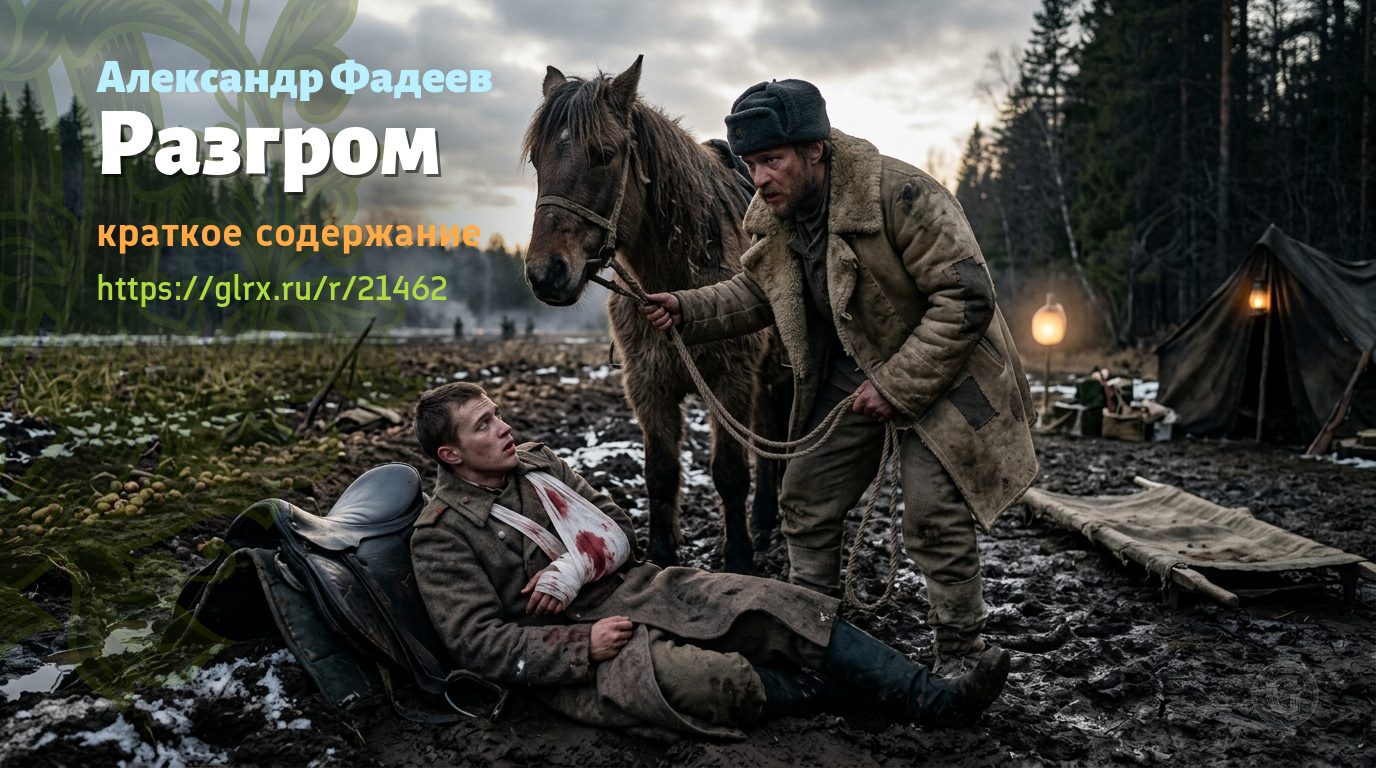
Partisan detachment commander Osip Abramovich Levinson tasks his orderly, Morozka, with delivering an important package to a neighboring commander, Shaldyba. Morozka is a second-generation former Suchan miner, a rough, mischievous fellow who loves to drink, but is infinitely loyal to his comrades. Along the way, the orderly witnesses the brutal defeat of the Shaldyba rebels by advancing Japanese troops. In a potato field, Morozka finds a wounded young man, Pavel Mechik. He throws the bleeding boy over his horse’s saddle, saves him from certain death under fire, and brings him to the partisan hospital.
Mechik, a former city schoolboy who joined the partisans with a voucher from the Socialist Revolutionary Maximalists, has difficulty adjusting to the harsh realities of the taiga. In the infirmary, his compassionate sister, Varya, Morozka’s wife, carefully tends to him. A mutual attraction quickly develops between the kindhearted Varya and the wounded young man. Morozka soon visits his wife. Noticing Mechik’s photograph of a blonde city girl, he rudely mocks the young soldier. Ashamed of the ridicule, Mechik tears up the photograph, forever harboring a bitter resentment towards his savior.
Melon theft and trial
The partisans temporarily stop to rest in a small village. Exhausted by the forced idleness, Morozka commits a disciplinary offense. He steals sweet melons from the melon garden of the local village chairman, Ryabets. An enraged Levinson decides not to hush up the incident. The commander recognizes his responsibility to the local population. Levinson convenes a full-scale village meeting with the detachment’s fighters for a public hearing.
Platoon commander Timofey Dubov, Morozka’s fellow countryman and a respected miner, sternly reprimands the offender. He publicly threatens to expel the thief, who is disgracing the honor of the entire miner’s rank before the peasants. Under the pressure of his comrade’s stern words, the shamed Morozka promises never again to take someone else’s property. The conflict is successfully resolved, and the peasants return home. Levinson cleverly takes advantage of the opportune moment and secretly orders Ryabets to dry out some crackers for the upcoming long march.
Forced retreat
Soon, alarming news arrives at headquarters about the concentration of superior enemy forces — regular White Guard troops and Japanese invaders. Commander Levinson clearly understands the dire need to preserve the detachment as a fully-fledged combat unit. The partisans stealthily leave the village under cover of night. They retreat through the impassable terrain deep into the taiga, heading for the Irokhedze River.
A fully recovered Mechik finally arrives at the combat camp. The commander assigns him to serve in Kubrak’s platoon and gives him an old, sick mare named Zyuchikha. Mechik is completely inept at handling a workhorse. The young man despises it and soon abandons its daily care altogether. He instinctively shuns ordinary soldiers, considering them rude, uncouth, and cruel. Mechik finds dubious solace only in the company of the cynical, lazy Chizh, who constantly criticizes all actions of the command. Varya tries to rekindle her friendship with Mechik, but the young man coldly and cowardly rejects her sincere love.
The harsh laws of survival
The enemy’s pursuit ring is inexorably tightening. The detachment retreats tens of kilometers along the most remote taiga trails.
The exhausted soldiers are starving, and food supplies are running low. Levinson is forced to implement extremely harsh military supply measures. In a remote Korean fanza, Levinson orders the last pig of a weeping old peasant to be taken and slaughtered. Mechik shudders at the cruelty displayed, trying to protest inwardly, but he eats the cooked meat just like all his comrades. The human factor takes its toll.
Partisan Frolov, hopelessly wounded in the stomach, remains in a hidden hospital. Transporting him across the impassable terrain is physically impossible, and leaving him to be brutally slaughtered by the enemy is absolutely unacceptable. Levinson gives Doctor Stashinsky a secret order to hasten the doomed soldier’s death. Mechik overhears this terrifying conversation and falls into a frantic panic. Doctor Stashinsky administers poison to Frolov, disguised as the sedative bromine. Frolov understands perfectly well and calmly takes the lethal dose. The terrified old man, Pika, unable to bear the bloody reality, secretly deserts the camp into the taiga.
Metelitsa reconnaissance
Levinson decides to send his bravest platoon commander, Metelitsa, on a long-range reconnaissance mission. The commander wants to reliably determine whether the road to the saving valley is clear. The nimble Metelitsa travels several kilometers and reaches a large village occupied by Cossacks. He quietly hides in a priest’s garden and attentively eavesdrops on the White officers’ card conversation. Unfortunately, the scout is spotted in the darkness. A brief firefight ensues. Metelitsa is knocked unconscious with a heavy blow to the head and taken prisoner.
Early in the morning, Cossack officers hold a public interrogation of the partisan before a herded crowd of peasants in the church square. Metelitsa holds himself proudly, defiantly, and maintains a contemptuous silence. For a confrontation, the Whites bring in a frightened little shepherd boy, with whom the scout had left his horse the previous evening. The faithful boy flatly refuses to betray the partisan. To save the child from reprisal, Metelitsa suddenly lunges at the squadron commander, attempting to strangle him with her bare hands. The guards immediately shoot the courageous commander.
The battle and crossing the swamp
Without waiting for the scout’s return, Levinson stubbornly leads his men forward. As expected, they run into a prepared Cossack ambush. A fierce firefight ensues, and the detachment breaks through to the forest, but their further advance is blocked by a vast, impassable swamp. From behind, superior enemy cavalry forces rapidly advance. The situation becomes critical.
The soldiers, overcome with wild despair, are on the verge of panic. Levinson, revolver raised, imperiously imposes order. He forces the men to dismount, cut down brush, and build a wooden causeway right under enemy machine-gun fire. With incredible effort, the partisans struggle through the swampy bog. Demolitionist Goncharenko skillfully mines the dam they’ve just built and blows it up right in front of their pursuers. The main detachment is temporarily saved, but many are killed in the brutal rearguard action. Among the fallen is the brave platoon commander, Dubov.
Betrayal and death
Mortally exhausted, the partisans reach the state highway. Levinson sends a mounted patrol ahead — Mechik and Morozka.
Mechik moves first. He is deeply immersed in self-pity. The young man passionately dreams of escaping to a cozy city, far from bloodshed and war. Suddenly, he stumbles upon a hidden Cossack outpost. Instead of raising the alarm and warning his comrades, Mechik abandons his horse and cowardly flees into the roadside bushes. A blind instinct for self-preservation overwhelms him.
Morozka, following along the road, also drives into an enemy ambush. The former miner instantly assesses the dire situation. Realizing that his own escape is utterly impossible, he thinks only of his exhausted comrades behind him. Morozka raises his revolver high and manages to fire three shots into the air, signaling mortal danger. The next second, a well-aimed Cossack volley ends his life forever.
The end of the campaign
Hearing distant signal shots, Levinson and his young assistant, Baklanov, immediately mobilize their detachment for a desperate cavalry charge. A brief but terrifying battle ensues. Baklanov is killed in the fierce firefight. Only nineteen wounded soldiers manage to break through the dense enemy ambush.
Finding himself completely safe, Mechik lies dejectedly in the forest bushes, realizing the immeasurable baseness of his actions. He desperately tries to justify himself, weeps bitterly, throws away his partisan weapon, and finally resolves to return to the safety of a peaceful life. Cowardice triumphs over his conscience.
Levinson leads the surviving partisans out into the open field. Upon learning from Goncharenko that young Baklanov has been killed, the stern commander breaks down under the strain and begins to cry. However, ahead lies a sunlit valley, where peaceful peasants are working at a threshing floor. Levinson suppresses his tears, stands proudly, and tells himself, "I must live and fulfill my duties." Life inexorably continues, and the commander leads his small detachment on.
- Александр Невский
- Александр Македонский
- Александр Бенуа: художник и сценограф
- Александра Вейхерт, современный скульптор
- Александр Архипенко: русский скульптор-кубист
- Александр Колдер: американский скульптор, художник-кинетист
- Русский авангардист Александр Крюков
- Стэнхоуп Александр Форбс, ирландский пейзажист, художник-деятель
- Экспозиция картин и гравюр
You cannot comment Why?