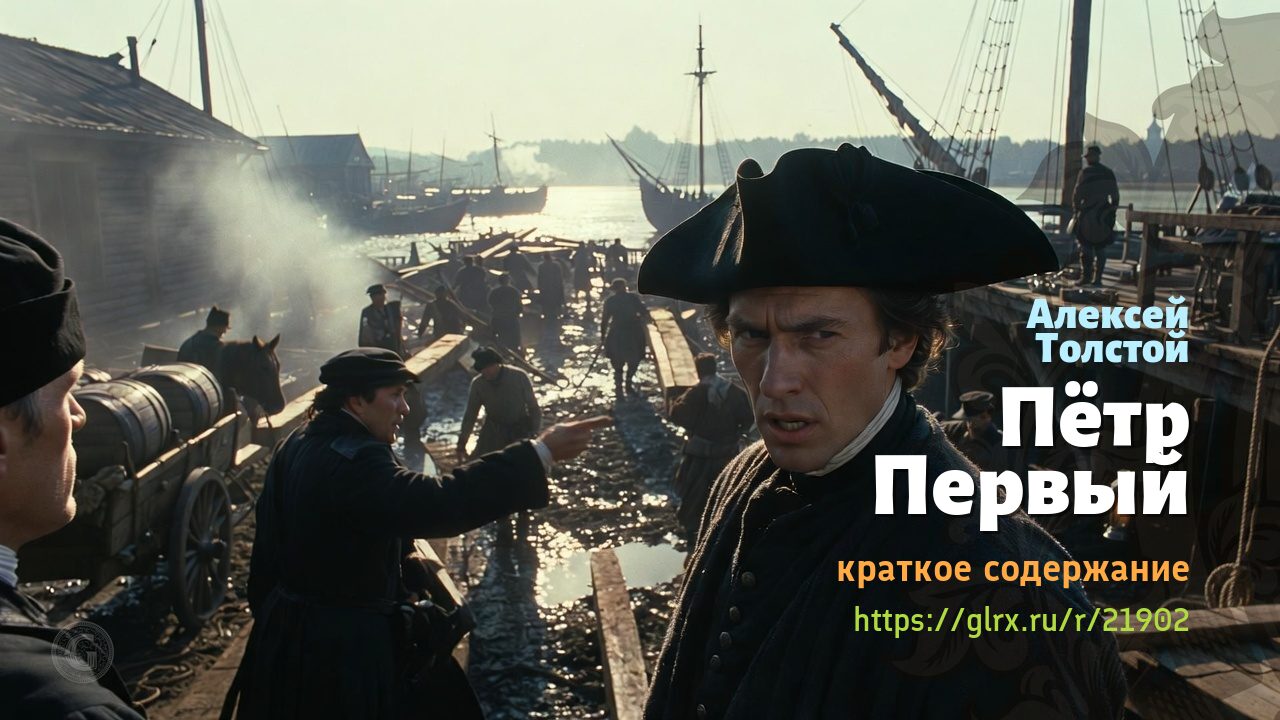
"Peter the Great" by Alexei Tolstoy, summary
 Automatic translate
This historical epic novel tells the story of the harsh era of the Russian state at the turn of the 17th and 18th centuries. Written between 1929 and 1944, the novel ends with the events of 1704 due to the author’s death. The narrative continues with the young monarch’s early military victories.
For his work on the text, the author was awarded the first-degree Stalin Prize in 1941. The book was successfully adapted into a film. In 1937–1938, a two-part film directed by Vladimir Petrov was released. In 1980, director Sergei Gerasimov released the celebrated dilogy "Peter’s Youth" and "At the Beginning of Glorious Deeds."
The period of regency and the youth of the Tsar
Ivashka Brovkin’s peasant family lives in poverty on the lands of Vasily Volkov, a small landowner. Heavy taxes and arbitrary government rule force people to live in poverty. Children sleep on the stove without shirts. Ivashka’s son, Alyoshka, can’t bear the beatings and runs away to Moscow. There, the young man meets an enterprising street child, Aleksashka Menshikov. They sell pies on the streets. By chance, Aleksashka meets the young Tsar Peter. Menshikov performs a trick with a needle, piercing his cheek until it bleeds. The Tsar is amazed and takes the boy as his orderly.
Following the death of Tsar Feodor, a rebellion breaks out in the Kremlin. Tsarevna Sophia Alexeyevna, with the support of the Streltsy, seizes power. The rebels kill Artamon Matveyev and the Dolgoruky princes, relatives of Tsarina Natalia Kirillovna. Two young brothers, Ivan and Peter, are crowned. Sophia becomes the rightful ruler.
Her favorite, Prince Vasily Vasilyevich Golitsyn, secretly dreams of renewing the state along European lines. In a dark dungeon, he consults with the sorcerer Vaska Silin. The prince then undertakes two Crimean campaigns against the Tatars. The army suffers enormous losses from the heat, lack of food, and steppe fires. Golitsyn burns the sorcerer alive in a bathhouse. The prince’s authority declines.
Peter lives in the village of Preobrazhenskoye, far from the Boyar Duma. He creates mock regiments, recruits grooms and peasant lads. Foreign officers supervise their training. The Tsar develops a close friendship with the Swiss Franz Lefort. In the German Quarter — on the Kukui River — Peter discovers new knowledge, free morals, and unbridled joy. Here he meets the beautiful Anna Mons, the daughter of a local wine merchant.
Peter’s mother, Tsarina Natalia Kirillovna, hastily marries her son to Evdokia Lopukhina. The marriage brings Peter no joy. He quickly loses interest in his quiet and pious wife, preferring the company of foreigners.
The struggle for power and first victories
The Streltsy revolt again, led by Sophia and Fyodor Shaklovity. Peter flees to the Trinity Lavra of St. Sergius. Foreign regiments, Patriarch Joachim, and the noble militia defect to the young tsar. Sophia is deposed and sent to the Novodevichy Convent. Vasily Golitsyn is stripped of his ranks and exiled to Kargopol. Shaklovity is executed after torture. Peter becomes sole ruler. He leaves state affairs in the care of the boyars and devotes himself to building a toy fleet on Lake Pereyaslav.
To gain access to the southern seas, the Russian army besieges the Turkish fortress of Azov. The first campaign ends in failure. Engineer Yakov Jansen betrays Peter by defecting to the Turks. The siege is lifted. In Voronezh, the Tsar immediately begins construction of a navy. Tens of thousands of people are herded into the shipyards, working under harsh conditions. The second campaign brings the long-awaited victory: Azov is captured with the help of the newly constructed ships. The traitor Jansen is captured and executed.
Peter sends the Grand Embassy abroad. He travels incognito under the name of Pyotr Mikhailov, a police officer. The Tsar works as a simple carpenter in the shipyards of Saardam and Amsterdam. He becomes familiar with European shipbuilding, hires craftsmen, and purchases weapons. In Europe, monarchs view the Russian Tsar with suspicion. The Austrian Caesar prepares to conclude a separate peace with Turkey.
Reprisal against the past
News of a new Streltsy rebellion forces Peter to cut short his journey. Returning to Moscow, he personally oversees the investigation. Bonfires burn in Preobrazhenskoye, and executioners work around the clock. Mass executions take place in the squares. Hundreds of Streltsy are hanged. Peter forces the boyars to behead the rebels. He orders nobles to shave their beards, wear European dress, and smoke tobacco. Old Testament Rus’ yields to his will. Peter’s sister, Tsarevna Natalia Alekseyevna, establishes a comedy theater in the old palace chambers.
His faithful friend Franz Lefort dies. Peter grieves over this loss. At the same time, the Tsar discovers a medallion with a portrait of Anna Mons and her love letters in the possession of the Saxon envoy Königseck, who drowned in a stream. The Tsar permanently breaks off relations with his unfaithful mistress, depriving her of his favor.
New manufactories are springing up across the country. Former peasant Ivan Brovkin becomes a prominent merchant, supplying the army with cloth and provisions. His sons rise in the world. Gavrila studies in Holland, Alexei becomes an officer in the guards, and Yakov serves in the navy. Pyotr marries his daughter Sanka to the nobleman Vasily Volkov, the Brovkin family’s former employer. The couple travels abroad. Nikita Demidov, a blacksmith from Tula, receives cannon foundry factories in the Urals from the tsar.
Popular unrest and schism
The drastic changes provoke resistance among the people. Entire communities of Old Believers flee to the dense northern forests, believing the Tsar to be the Antichrist. The fanatical elder Nektariy calls on his followers to immolate themselves for the salvation of their souls. In one of the forest hermitages, Nektariy locks hundreds of people in a wooden chapel and burns them alive as a detachment of soldiers under the command of Alexei Brovkin approaches. Nektariy himself secretly escapes through a dungeon.
Having escaped religious fanaticism, Palekh icon painter Andrei Golikov wanders the country. He longs to paint living pictures, not austere icons. Fate brings him into contact with escaped bandits. Then Andrei is sent to hard labor in the city of Piterburg, which is under construction. There, Golikov draws a charcoal painting of a naval battle on the wall of a dugout. Piter sees this drawing and takes the talented young man under his wing.
Northern War
Peter forms a secret alliance with the Polish King Augustus and the Livonian nobleman Patkul against the Swedish monarch Charles XII. In the autumn, Russian troops besiege Narva. The Swedish king launches a surprise attack through a snowstorm. Due to the betrayal of foreign mercenaries and poor organization, the Russian army is routed. Peter abandons camp on the eve of the battle, going to Novgorod for reinforcements. Artillery is lost, and the generals surrender.
The Narva embarrassment becomes a harsh lesson. Peter takes church bells to cast new cannons. Regular army regiments are formed. Field Marshal Boris Sheremetev wages military operations in Livonia, devastating Swedish territory. In the battles of Erestvör and Gumelshof, Sheremetev achieves resounding victories over General Schlippenbach.
Meanwhile, King Charles is mired in Polish affairs. He pursues King Augustus, ignoring the threat from Russia. The Swedish monarch displays a fanatical passion for war, sparing neither his own nor foreign soldiers. Augustus leads a frivolous life, indulging in luxury in the company of Countess Kozelska and Lady Anna Sobeschanska. The Poles are divided into opposing camps, with many nobles supporting the new king, Stanisław Leszczyński.
Establishment on the banks of the Neva
Russian troops storm the ancient fortress of Noteburg at the source of the Neva. Oreshek is renamed Shlisselburg. The fortress of Nyenskans is then captured. Access to the Baltic Sea is opened. At the mouth of the Neva on Zayachy Island, Peter the Great establishes a new fortress, Piterburh. The first wooden structures are erected. On Kotlin Island, Fort Kronshlot is founded to protect the young city from the sea. The construction of earthen and stone fortifications proceeds under difficult conditions.
In the captured Marienburg, the Russians take many prisoners. Field Marshal Sheremetev notices the beautiful Katerina, the former servant of Pastor Gluck. Alexander Menshikov, now a general and governor, takes the girl for himself. Soon, Peter meets Katerina at Menshikov’s. The girl captivates the tsar with her simplicity, cheerful disposition, and affection. She becomes Peter’s faithful companion.
The Tsar reorganizes the army. Russian ships are launched. Peter takes advantage of the respite to lay siege to Yuryev. He personally arrives at the camp and repositions Field Marshal Ogilvy’s batteries. Accurate artillery fire at the "Russian Gate" creates a wide breach. The besieged Yuryev is taken by storm.
In the summer of 1704, Russian troops approached Narva again. To lure the garrison out, Menshikov staged a ruse. Some Russian soldiers disguised themselves in blue Swedish uniforms. A mock battle ensued.
Narva’s commandant, General Horn, believes Schlippenbach’s troops are coming to the rescue. He opens the gates and releases the garrison. The Russians crush the detachment that has just left. Soon, a general assault begins. The soldiers overcome the ruined bastions of Victoria and Honor and storm into the city. The massacre begins.
Peter personally stops the bloodshed, striking a Russian soldier for violence. Menshikov is appointed governor of Narva. The captured General Horn is brought before the Tsar. Peter denies the stubborn commandant military honors for his senseless resistance. The Tsar orders General Horn to be marched across the city to prison. He proclaimed: "Take him to prison, on foot, across the city, so that he may see the sad work of his own hands…"
- Exhibition for the anniversary of the artist Sergei Menshikov in Novosibirsk
- At the Yermolova Theater, the anniversary season was completed with the presentation of prizes
- At the Yermolova Theater, the season was finished with the Andrey Lobanov Prize
- "Vita brevis" - personal exhibition of the artist Danila Menshikov
- Ivangorod is amazed at the work of a new generation of artists from Russia and Estonia
- "The Romanovs: Mistakes of a Great Dynasty" by Igor Shumeiko, summary
You cannot comment Why?